Saturday, April 16, 2011

The Lemon Tree


A history lesson and a story of friendship between an Israeli and Palestinian is the backdrop for this very good read, The Lemon Tree by Sandy Tolan.  Tolan does his homework in providing a timeline of the history of the conflict and how each group was pushed out of their homelands to where the two ethnic groups were forced to be in conflict.  I am not a history buff but many of the names of the Secretaries of State, UN leaders, and Presidents of the various countries brought me back to “the day,” well at least to the 1970s and 80s when I (as the song goes) “wore a younger man’s clothes.”   The back of the book lists all of the various sources cited and interviews conducted by Tolan.  This true life story of two people (Dalia and Bashir) from worlds apart collide when the two main characters meet face to face when Bashir (a Palestinian) and his two cousins visit their childhood home, now occupied territory of the Israelis.  A gracious Dalia allows the three men to visit and tour the home.  After hearing that her home, which she and her parents moved into a decade earlier, had been Palestinian homeland and was the home of Bashir and his family, she was quick to invite the men in.  As a sign of a peace offering, Dalia offered some lemons from the tree that Bashir’s family had planted when they resided in the home.  The mass exodus of the Israelis was a result of agreements signed by Arab states, European countries, and the US.  This is the backdrop for two lives that would be intertwined forever and connected to make the past a learning lessons for the future.  Through a 15 year jail sentence, bombing of a school bus that almost killed one protagonist’s child, and the fear of never coming home, the lives progress through a plan of finding one’s place.  Here is a picture of the two who work toward a mutual understanding and respect for their heritages, their stories, and their belief to fight for their ancestor’s heritage.


The two met in 1967 and continue to have a relationship searching for a hope for peace.  There is rarely a “storybook” ending in life, but clearly there remains that home!   Great NPR listen to the Palestinian/Israeli backdrop with Bashir/Dalia relationship by author Sandy Tolan: http://www.npr.org/templates/story/story.php?storyId=5405369.   Again, great perspective on why the problems exist in the Middle East between the Palestinians and Israelis.  Two different stories where hearing my story doesn’t really mean I will understand it!  If you are interested in the history of the two groups, this is a MUST read. 

Wednesday, April 13, 2011

Bonus Book: The Precious Present


Every once in a while you read a story that just warms the center of your heart, this one should do that for each person who reads it.  Sometimes lessons that are taught take a long time to sink in, and some lessons can be learned by reading a very short book. So it goes with Spencer Johnson’s The Precious Present.  This was a favorite book of a former staff member at NYU and served as the basis of my keynote for Sunday’s NRHH induction ceremony.  The short story follows the life of a young boy who is engaged in a conversation with an older man who talks about his hopes for the boy to receive the “precious present.”  The boy asks when he will get the “gift” and is it something he will get wrapped or in a box?   "No," the man quietly replied.   "When you have the precious present, you will be perfectly content to be where you are."  The boy spends years wishing and hoping for the present as he gets older and older until he confronts the old man and here is what the old man shares: “THE PRESENT HAS NOTHING TO DO WITH WISHING. . . WHEN YOU HAVE THE PRESENT YOU WILL BE PERFECTLY CONTENT TO BE WHERE YOU ARE. . . THE RICHNESS OF THE PRESENT COMES FROM ITS OWN SOURCE. . . THE PRESENT IS NOT SOMETHING THAT SOMEONE GIVES YOU. . . IT IS SOMETHING THAT YOU GIVE TO YOURSELF. . . .”  The boy is overjoyed when he finally understands, but then wonders aloud why hasn’t he ever allowed himself to live in the precious present. As he learns, "The present is simply who I am, just the way I am, right now.  And it is precious.  I am precious.  I am the Precious Present."  Ah… so often we look at our futures and forget to really and truly enjoy our current situation.  Now is the precious moment that we are living.  We do not know what tomorrow brings, but if we allow ourselves to be thankful and take in this second, we really can begin to enjoy this moment in life.  Amazing to me how few students in the room ever heard of this very simple lesson and story of Johnson.  Add this 15 minute read to your collection at least once a year if not more to experience The Precious Present.  Enjoy!

Tuesday, April 12, 2011

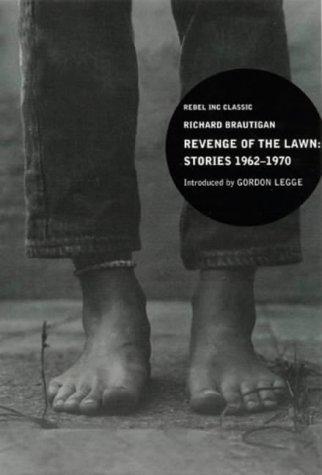
Revenge of the Lawn


Short stories can be fun to read, especially when they are humorous, reflective, and contain something a little different.  Well this one did…  Revenge of the Lawn by Richard Brautigan is a collection of short stories which provide a flavor of “Oregonian flair” and themes of war, hunting, dating, and some seriously funny tales, truncated style.  And then there are short stories that blur the lines, humorous and hunting related… “It’s very hard to live in a studio apartment in San Jose with a man who’s learning to play the violin.  That’s what she told the police when she handed them the empty revolver.”   Brautigan offers glimpses into the lives of the “on the farm” or “next door neighbor” type characters.  Folks we overhear at the grocery market or sitting next to us at the barber getting their hair cut.  For me a view into the life of the West Coast contingent, you know what I mean, I’m sure.  This was a really fun read.  All of the stories, 50ish or so, were all under three pages, and some were a paragraph long, so no excuses not to read this one.  Thanks to my RA friend in Third North who lent me the book.  I didn’t lose any of the pages that were falling out!  Add this hidden gem on your list.  Smiles and those small laughs will flow.

Monday, April 11, 2011

The Passion


The Passion by Jeannette Winterson is a story of love and lost love told from the perspective of two characters, Villanelle, a cross-dressing, web-footed, red-headed woman from Venice, and Henri, a young French boy who is thrust into the scene as Napolean Bonaparte’s cook. The first two chapters tell the personal sagas of the two characters.  In chapter one, Henri covers for the cook when Napolean decides to visit the kitchen and finds young Henri doing great work with the food, while the cook is drunk on the floor.  Bonaparte is so enamored with Henri’s work that he installs him as his personal cook.  Henri lives through eight years of service also on the front line, but always in the kitchen. Then we switch to Villanelle and her life dressed as a boy working in the casinos, and eventually falling in love with a woman customer whom she visits while the woman’s husband is out of town.   Chapters three and four provide the story of how the two characters' paths cross, Henri falling in love with Villanelle.  The reader also learns how Villanelle has had her heart ripped out by her married female lover.  We learn that “Passion” is not safe and love is not always returned.  Henri falls for Villanelle, but what happens to that love?  Can Villanelle escape her life as a prostitute, gambler, and heartless woman?  Henri will go to any lengths to demonstrate his love for Villanelle, but how will Villanelle respond?  What role does Bonaparte play in influencing his loyal soldier Henri?  Will France overtake the world? Well, we actually know how that part ends for us history buffs.  Winterson does a nice job interweaving intrigue in a setting of love and war.  Well done with lots of levels of understanding in this one!

Saturday, April 9, 2011

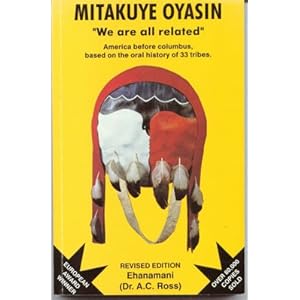
Mitakuya Oyasin- We are All Related


Moving from one cultural perspective to another was today’s rather brief read, Mitakuya Oyasin- We are All Related by Dr. A.C. Ross.   Having a life-altering experience (unable to walk) with doctors baffled at how to respond, Dr. Ross decides to go back to his roots for a last ditch attempt to respond to this life changing ailment.  What he learns in the journey changes his life.  Ross and his wife travel from their home in Denver to South Dakota to participate in a ceremony to bring the spirits to respond to his unknown medical issue and Ross is “cured!”  As the process unfolds we learn from Ross how much his cultural upbringing (traditions and rites) are actually embedded in most of American culture, but with a different name and different process.  This quick read explores the psychology of Jung and comparing it to much of the Native American rituals.  Additionally, Ross stresses the importance of using both sides of the brain in our daily functions.  This life lesson is great for anyone who thinks about the Jewish, Muslim, and Christian religious traditions.  Ross’ book is a very conversational type writing style which illustrates Ross’ learning as he connects back to his tribal upbringing that he seemingly was never interested about when he was growing up.  A few nice lessons in language connection within the Native American community and our own and in the end how similar we really are as communities is the biggest take-away.  Cultures are usually taught through differences but what Ross is attempting to do is draw us closer together.  Well done Dr. Ross! 

Friday, April 8, 2011

Directed By Desire


Poetry upon more poetry in this epic-length book of poetry that I have been engaged in reading for longer than I can say, a little each day.  While engaging, boy were there a ton of poems!  Directed by Desire by June Jordan, whom is a prolific poet, shares decades of moments and experiences in her book.  Jordan displays wisdom, sadness, fear, and independence in her work that spans forty years of plight for the African American community during the 1960s until her death from cancer in 2002.  The civil rights issues,  sexual assaults, personal humiliations, untold deaths of African Americans, and challenges facing women in a culture of male domination are all beautifully told by Jordan.  Jordan’s command of not only painting pictures but emoting feelings which are raw (at times) was always on target and had me, the reader, in her moments.  I am not a huge poetry reader, but Jordan’s poems were “spot on” and gave me so much depth of feeling.  She captured the moments of an ever-changing culture.  Reading in small doses is the only way to truly benefit from Jordan’s moments of brilliance.  Add this one to your list not only to gain a better insight to Jordan’s life but also to have a better understanding of woman of color’s view of the American scene at the time.  

Thursday, April 7, 2011

A Prisoner of Birth


Traveling to Smith College and just finished a GREAT book by Jeffrey Archer, A Prisoner of Birth.  This mystery parallels in many ways a 21st century The Count of Monte Cristo by Dumas, which I also loved. The story of two sides of the tracks from England’s West End and Southside.  The protagonist, Danny Cartwright, is accused of killing his best friend outside a bar, but he didn’t do it, except he was in the wrong part of town, and the actual killer was able to have Danny arrested.  The “four musketeers” as they are fondly referred to in the story, led by Spencer Craig, are actually responsible for the cover-up of Craig’s actions as murderer.  The book chronicles Danny’s court trial, time in jail and then a twist occurs.  Danny’s jail mate (Sir Nicholas Moncrieff) commits suicide.  Or is he killed?  Danny and his other cellmate (Big Al) create a plan for Danny to disguise himself as the recently deceased Moncrieff.  Once Danny escapes, he leads Sir Nicholas’ life in which he inherits land and a stamp collection, much to the dismay of Moncrieff’s long lost uncle.  Court cases, Danny facing three of the four musketeers (one dies suddenly while also in jail), and Danny’s reunion with his long lost love (the sister of the deceased friend) all make for a drama of epic proportions.  This mystery/love story with intrigue at every corner is also like another favorite of mine, Shadow of the Wind.  I realize that I really do enjoy the mystery-type stories.  Add this to your list.  Archer is an outstanding author who has developed a story worth reading, though I listened to it!  A 2008 published book, so a nice recent one.  You should enjoy!

Sunday, April 3, 2011

Courage: The Joy of Living Dangerously


First, thanks to Nicu (Gramercy RA) who provided me a copy of his favorite book, as I wasn’t able to find it ANYWHERE! NY Public Library didn’t have it, NYU didn’t have it, hmm.. a hidden gem?  Yes, Courage: The Joy of Living Dangerously by Osho was a good one.  This is a great read that reminds one of the need to place reflection/meditation high on the list of things to do every day.  “Don’t call it uncertainty, call it wonder, don’t call it uncertainty, call it freedom,” ah yes!  Live courageously, I guess that is a theme in the books in the last few days starting with Patriotism.  Courage, as Osho defines, is “going into the unknown in spite of all the fears” and puts them aside and enjoys the ride.  We live such a specified life, in which I mean, we specify what success is, what our homes will look like, our friends will be, and how much money we need to live, yet Osho suggests we live a different type of life.  While religion can play a role, the prescription of a religion may be limiting for us to find spiritual awakening.  There are so many pockets of intelligence in the book and concludes with a brief “how to” for meditation.  Some of my favorite pieces include: to be engaged in something or relax, why is there more crime, rape, murder, suicide, and robberies on the weekend after we were engaged for five days in the week?  Interesting thought, maybe being engaged is a good thing?  Meditation is nothing but the discovery of the inner self.  God is not a person but the ultimate sense of well-being, the ultimate sense of being at home, where “I belong to this world.”    In life we should expect nothing, yet we should be ready for everything, but are we?  Does our own expectations for the home, the job, the timetable of life’s days hold us back?  One of my favorites, risk, not the game J but the way we approach life is the only guarantee for being truly alive.  I guess that is why the mountain climbers take the challenge.  What is your risk taking for the day?  Always remember that “new is always better than the old” as it relates to our learning and how we approach tomorrow.  Choose the unknown (the risky) as the dangerous and insecure will not end up being a loss.  I love the section on boredom.. write this one down all. Boredom simply means that the way you are living is wrong!  I LOVE THIS STATEMENT, so true!  And he concludes, fear is no more than six inches away.  You can stay on the branch (hanging there) or leave it and stand on your feet on new ground.  Nicu, thank you for this book.  Osho has wisdom beyond years in this book to share.  Get your copy, I hope easier than I did. I think I have a lot of Twitter TODs (Thoughts of the Day!)!  Great read.

Saturday, April 2, 2011

Austerlitz


Mix architecture and a child looking for his heritage and you have Austerlitz by W. G. Sebald. The protagonist in this novel is Jacques Austerlitz while the man he befriends is the author who has a series of interactions throughout the book.  Austerlitz learns during his mid adult age that he actually was adopted and strains to remember the various pictures he has from his past, learning that he in fact was not Dafydd Elias, whom he had grown up as in his early life at school, though he does have some memory of life before age 5.  The author is enamored with architecture and brings us through a series of places and structures (my own editorial note, you gotta get a glimpse of some of the pictures, seemed as some rather interesting choices, realistic and didn’t always fit my thoughts on the story).  We learn Austerlitz was transported from Czechoslovakia which was being threatened by Hitler’s regime at the time.  We travel with Austerlitz as he begins to put the puzzle pieces together of his youth from Prague to Theriesenstadt (a camp “ghetto for Jews”) to present day Paris. The narrator and Austerlitz discuss the role of the records from the Hitler regime, records stored in the various libraries in France that help him tell his story.  We as the reader are brought into the missing abyss of Austerlitz life piecing together the structure of his life with the structures of the physical pieces during the World War in Europe.  An unsettling and almost unfinished book in that it left me thinking about how images and structures are sometimes the things that bring back our feelings and memories.  The structure of the book is quite inventive, no chapter breaks and a few really long passages with seemingly no pauses in writing.  Again, the pictures are eerie in the day of Austerlitz's upbringing mixed with 1970s black and white contemporary (for its time) pics of the area.  For those who like historical and psychological metamorphosis-type books, read it.  The writing is quite good.  

Friday, April 1, 2011

Patriotism


Date: February 28, 1936
Event: the date of the incident 
Book: Patriotism, by Yukio Mishima. 

An ethical dilemma leads to a courageous event (death by his own sword), or at least that is how Lieutenant  Shinji Takeyama of the Japanese battalion chose to die after learning he was placed in command of the group who would capture and kill his own best friends after they defected from the military.  When Shinji returns to his recently wed partner, Reiko, he shares that he would be incapable of hunting and killing his lifelong friends.  He informs Reiko of his decision to take his life and Reiko, the ever faithful wife, agrees to watch the act so she can verify his honorable death and then lets him know she will also take his life.  And to think this is actually a pre-cursor to Mishima’s own death, coincidence?  This book, a very short story, was beautifully written by Mishima.  The depth of love and honor shown by Shinji and Reiko and their commitment to each other into the otherworld was hard to imagine.  This was a love story to the end.  The sensuality and tears shed going into an act of defiance to your country, yet commitment to your friends makes for an ethical dilemma.   Riveting, sad, and one that stays in your memory for a long time I am sure, I highly recommend this book as you will fall in love with the commitment that one person has for their spouse, yet yell outloud for them to run away and exhibit their love on this earth for years to come. Be in the mood for this one.