Time to venture back into the Victorian era of the late 1800s to England and the story of Gemma Doyle and her new life at a boarding school. This is the first of a trilogy by Libba Bray called A Great and Terrible Beauty. Gemma is sent to the boarding school after her mother dies suddenly from an apparent suicide, though her family tells others that she died of cholera. Gemma is “haunted by visions” of spirits that come and go over the course of her young life, which she has yet to fully comprehend. While at Spence Academy, Gemma is an outcast among her peers at the school when she arrives and is placed with the awkward stutterer, Ann Bradshaw. Ann and Gemma are challenged by the “mean girls” of Spence Academy until Gemma catches one of the ring leaders, Felicity, in a compromising situation with a male gypsy. Gemma uses the information in a way to control Felicity’s mean spirit and actions towards her and Ann. As they become friends, Gemma is led into the caves that border the school grounds by one of her visions. There, she finds a diary written 25 years earlier by a 16-year-old girl named Mary Dowd who also attended Spence Academy and seemed to suffer from the same visions as Gemma. As the story unfolds, Felicity and fellow “mean girl” Pippa join forces with Gemma and Ann and become intrigued by the history and stories Gemma shares with the others about her background and the hidden group called the Order. The Order was a group that allegedly formed at Spence Academy many years ago and is confirmed by one of the teachers at the school. In fact, the teacher brings the girls to the caves as part of class, the same caves that Gemma has had visions of in the past. When the girls put the caves and the diary stories together they want more and more interaction in the caves and a visit to the realms, which Gemma has explained through her visions, and tells the girls of her secret powers, which at one point she uses to assist Ann in enhancing her singing and the other girls with their looks and brains. Things get really interesting when Gemma’s mother appears, Pippa falls into the waters, and the spirits in the realms turn on the girls. How will they escape this awful drama that they have gotten themselves into? Which one of the four will suffer a tragic fate? Will the spirit of Gemma’s mother be helpful in saving Pippa? This fantasy Victorian story is a nice read but falls apart for me when I find out… it’s a trilogy! I didn’t know before I started. What happened to the days where stories had a beginning, middle, and ending in one book? Oh well, well written and had some surprises along the way. Not bad.
Sunday, May 15, 2011
Saturday, May 14, 2011
The Evolution of Morality
Time to jump back into reading textbook hypothesis and thinking deeply on the human condition in The Evolution of Morality by Richard Joyce. Pretty dense arguments by the author on how we as humans act when faced with something. Is it nature, nurture, or a combination of something else? Joyce presents data from other classic text books that I have spent some time reading like “The Selfish Gene” and works by Dennett. Joyce takes us back to the cavemen and how we evolved as a culture on how we determine to act, either to help or turn our back. Is moral decision making by the natural selection model and how our brain operates or has it evolved through our ancestors and serves as a method from some level of reciprocity between two beings. Joyce often uses studies of animals in making his points. The nice thing about the book is that he tends to give examples that are understandable and easy for us “simpletons” to “get.” How did we as a culture of humans begin to help one another, what is morality? Creating a moral code/language to communicate and finally the vindication and debunking of morality are a few of the chapters that serve as the basis for this book. Be prepared to re-read a few of the passages before you had the “ah-ha” moment. For morality and philosophy buffs, I’m sure it is on your top 100 books of the 21st century. For those who see reading as an escape to another world, probably will need some serious high level of caffeine to keep going through the book. The nice thing is it is relatively short in page numbers. Probably a staple for most philosophy majors, but for me ok – I get it, but…. To think he is younger than me…why am I not that smart?
Friday, May 13, 2011
One Bullet Away
This was an interesting read for me as my youngest son Alex has been toying with the idea of doing some form of the military during his time in college. I am hopeful he will read One Bullet Away by Nathaniel Fick. Fick’s story starts at Dartmouth College at the end of his junior year when he decides to take a stab at Officer Candidate School in Quantico, VA. Fick presents a detailed description of the personal physical and mental challenges faced by people who are exploring this option in their life. As a person who experienced military life in a very cursory way, in high school ROTC, I never understood why one would want to be disciplined in such a manner, nor be placed on the battlefield with people who become your best friends, only to realize how quickly it all could change. Fick succeeded in entering the Marines after his graduation and serving as an officer in 1999 and enjoyed upward movement into the Marines’ First Recon Battalion as a Captain in the elite group. After two years of service, 9/11 occurred and Fick was deployed to Iraq. With the stories of the death of civilians, road carnage, developing strategy to win with no lost life and taking care of his men, the reader gains a true admiration and respect for the work our military provides for this country, which is a separate issue from should we actually be in another country to jeopardize the lives of our young men, and I mean young... 18, 29, 20… SO much life in front of them, but… Fick arrived in Iraq days after the Sept 11th attacks. After a few years of service he was finally given the news of his return. He tells of his decision to leave the Marines and why should any person contemplating the decision to enter give a moment to pause and reflect. I did. Well written, though I listened to this one on tape, and even better read… by Fick himself! A great book for anyone who has a loved one thinking about the military as I think it is a pretty solid personal true reflection of “what life is like,” knowing all various branches of the military have nuanced differences.
Thursday, May 12, 2011
The Book of Daniel
I read a compelling novel by E.L. Doctorow called The Book of Daniel. The story follows the life of Daniel Lewin, formerly known as Daniel Isaacson, son of Rochelle and Paul. The story is based on the true life experience of Julius and Ethel Rosenberg, alleged to be Communists living in America during the late 1940s-early 50s, who eventually were executed for espionage. Doctorow presents a first person narrator, Daniel, from his youth with his sister Susan, experiencing the pain of having his parents arrested in their home, being separated and placed in a children’s home in the Bronx, to the trial and eventual death of his parents. The book jumps from the present time, 1960s, back to early childhood and then to events during the trial. Little attention is paid to the alleged “espionage activities” of the parents. Daniel’s pain of trying to comfort his younger sister and create some type of normalcy when all else is falling apart around him, including the onset of the hippie era, makes for a well written story. As a young child at the end of the “hippie” era, many of the moments described by Daniel brought back vague memories. It was a tumultuous time with fear, anarchy, and true activism (where has that gone???). Susan’s debilitating psyche, which ends in her own suicide, tears one apart knowing how the innocence of a youth is torn away. The story ends with Daniel’s confrontation with the man who turned his mother and father over to the authorities. Griping scene leaving the reader to decide their own interpretation of who really was guilty of espionage. Doctorow’s work is impeccable and I think this is a dynamic book of its time. Presenting a time which seems unbelievable, executing people with limited data, but illustrating how the fear of a country could create unheard of action. Hmmm… maybe we are seeing similar actions today with illegal immigration and our perceived desire not to be a melting pot any longer? Thumbs up for telling this story.
Monday, May 9, 2011
Winter’s Tale
A few times over the course of reading/listening to your favorites I really drag on a book, this was one time! It took about 8 weeks to finish listening to this one, which I am sure impacted my ability to focus, and more importantly enjoy this one – so that is the disclaimer. Winter’s Tale by Mark Helprin takes place near the turn of the millennium in New York City, but not necessarily completely like the one we know, though there are a good deal of references to places like Central Park, the West side, and even the defunct St. Vincent’s Hospital. This fantasy type book brings to life burglar Peter Lake, the protagonist, who attempts to rob a mansion on the Upper West Side of the City and in doing so finds the love of his life, Beverly Penn, who eventually dies. He is driven by her memory throughout the tale which has a backdrop of the never-ending cold and despair (blustering winds, dark nights, & snowy days) of winter. Clearly the book is influenced by Shakespeare’s drama by the same name, where a lead character disappears for years with no known reason and then reappears transformed. The reader does get a beautiful description of NYC, which hey, I love myself. The story runs the whole gamut from early 1900s to 1999 so the changing industrialization of the city is presented and how the community interacts from the changes. The style of writing is descriptive and beautiful, though quite long… I think the overall story may have been lost in some parts to me by the voice of the reader who I felt did no better than to tire me throughout. You really need to pay attention to the various characters that came in and out of this tale. I will say a lovely happy ending does occur. The book is lauded with awards etc.; however, not entirely my type of reading, but can understand based on the style of writing why it has such high praise. A pass for me, though others will disagree. Just be prepared for a long read…
Sunday, May 8, 2011
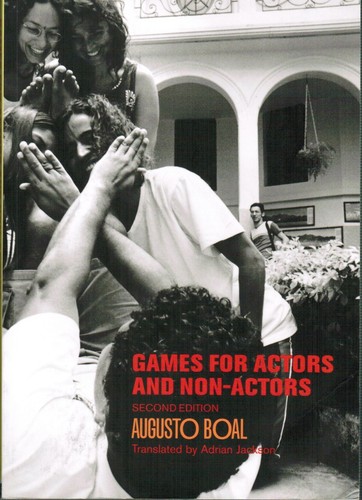
Games for Actors and Non-Actors
Text book at its best… ugh! Having received an MFA in Theatre I wondered whether Games for Actors and Non-Actors by Augosto Boal would be a helpful read or not. Hmmm… I will say the brief introduction to the various methods of acting contexts (Theatre of the Oppressed, Image Theatre, and the Forum Theatre) were blasts from the pasts for me but other than that, I have to say I was surprised by a number of things, mostly that this would be someone’s favorite book. My wife actually asked me: do you think some RAs just look in their book bag before meeting with you to think of a favorite book? It wasn’t until I finished the “Games” book that I now actually think it is possible. Since I do feel beholden to give a brief summary for the books, so you may not want to take the time to read the entire book, I’ll ruin the surprise on this one…. I guess there is some level of value to the book in that the “games” suggested might be fun at a family gathering, or a RA training, or a dinner party. Maybe the one that people place their butts next to each other and share “energy” or the “Murder at the Hotel Agato” game… isn’t that the mystery dinner game? Sense memory of touch, smell, remembrance activities, the image and the object, the mirror sequence, and the list goes on and on. Don’t get me wrong, this could be really helpful for an aspiring actor, or better yet, a director in attempting to move an actor from one place to another, but…. some of the exercises, or should I be more explicit, the variations on the exercises were pretty trite. Helpful to acting students but for the general reader, take a major pass. There are some funny pictures of actors performing some of the exercises, so pick up the book if you see it on a shelf (pg. 61 has the butt to butt exercise). Take a pass on this one!
Saturday, May 7, 2011
The Dream Songs
Poetry is not really my “thing” when I think of picking up a book to read, but The Dream Songs by John Berryman was surprisingly a great venue for me to further my appreciation of such writing. The book contains 385 poems whose format becomes familiar to the reader as the book progresses, with three stanzas in each with six lines per stanza. At first the poetry reader, in this case me!, is very confused by the poetry. Are the poems connected? What is the running theme(s)? Who is Henry? Why so much pain? And then a deeper yearning to learn about Henry, aka Mr. Bones, as referred to by his anonymous friend. Henry is an early middle aged white man, who decides to be in blackface (like in a minstrel show) and has struggles in love, religion, boredom with life, and vision in his dreams. There are moments of laughter, his eating problem which leads to his gastro issues, and then to his deeper moments of dealing with loss and the struggle of man to understand what is life all about. Henry questions suffering and morality of man and then introduces famous lines from children’s poetry, almost like how our own brain functions, as I look out my office window in Washington Square Park and let my mind wander to the “who,” the “what,” and the “how” of life. Taken as single moments and thoughts tied together by this questioning man come together in an uncomforting way. One particular poem captures the essence of the confusion:
All the world like a woolen lover
once did seem on Henry's side.
Then came a departure.
Thereafter nothing fell out as it might or ought.
I don't see how Henry, pried
open for all the world to see, survived
once did seem on Henry's side.
Then came a departure.
Thereafter nothing fell out as it might or ought.
I don't see how Henry, pried
open for all the world to see, survived
Berryman’s work is masterful, capturing wit, “true gut experiences,” and honesty on the challenge of emotion and feeling. There is an emotional power contained in the poems that spoke to me as reader, but more to me as a man who thinks through this confusion of everyday life. I wish I was this brilliant. Take in small sections. Moving in so many ways. Add to your list!
Wednesday, May 4, 2011
Redeeming Love
Every once in a while you read a book that has a heartfelt meaning and is well intentioned but you know what… just not your cup of tea, as they say. Well, that happened when reading Redeeming Love by Francine Rivers. The story is inspired by the book of Hosea from the Bible. The central theme of the book is to characterize the redeeming love of God towards sinners, in this case Sarah who is born through a tryst between the married Alex Stafford and her mother Mae. Sarah meets her father during one of his “visits” to Mae and learns that she is born out of an illegitimate arrangement that has been going on for years. Sarah is taken away by her mother’s maid, (all monies for Sarah’s upbringing has been given by Alex) but at some point that pipeline runs dry and Mae is forced to leave and take Sarah with her. Eventually Mae dies after being on the street as a prostitute and leaves Sarah to her uncle, who for money sells young Sarah into the world of prostitution. Fast forward to Sarah, now given the name Angel (you know this name has some double meaning – hit the reader over the head with this!) by her new “parents,” I mean owners of the house of ill repute. Angel is beautiful and becomes the number one “money producer” for the ladies’ house. Eventually a Christian man, Michael Hosea, sees Angel on the street and immediately falls in love and plans to take her out of the whorehouse. He pays the fee to meet with her, but spends the time offering to marry her. That doesn’t go very far at all… for the next six months Hosea returns and offers his undying love. Finally, Michael takes her to his farm after he finds her beaten up after refusing to turn tricks and marries her! The rest of the story shares the struggles of Michael and Angel (Mara, Irzah, or whatever her name becomes every time Michael falls more deeply in love with her). Angel runs away as she doesn’t understand the feelings for Michael and the draw that the “devil” has in speaking to her that she does not deserve such a man. Michael is so stricken by her and the will of God to help change her ways that he gives up all to try and win Angel over. Even after his brother-in-law Paul (whose wife died years earlier) has sex with Angel, Michael still wants Angel as his wife. The pull to the darker side by Angel and the pull to love her from the voice of God into Michael’s ear continues throughout the story. You can only guess the ending… yes, ends happy! There are a few more characters and struggles of Angel, but I think you get the idea. Evil is thwarted by good through the hand of God! You probably have seen this story on the Hallmark Channel if you are “lucky” enough to get it. Very predictable story. Not all bad, just not for me. Take a pass.
Monday, May 2, 2011
Limbo
An absolutely beautiful real life story from author Manette Ansay called Limbo. One gets a real appreciation for what one has after reading this book. I was touched by her struggles and how she hit rock bottom and then something happened… In the story, Manette traces back to her childhood memories, when life was easier and “forgettable.” She does this after meeting the challenge of her life, the complete deterioration of her physical body for no known reason. The story actually begins at the moment when she is facing her unknown ailment. The reader is then transported to how she began her journey of life. Manette grew up one of two children and was introduced to piano from a very young age. She had a talent and her parents helped cultivate it by bringing her to the best possible piano teachers. Manette put all of her energies into piano, even at the cost of making friends and being involved with others. High school was a series of bullying and being made the brunt of jokes and humiliations. Manette’s training allowed her to gain entrance to the Peabody School in Baltimore, Maryland. As the story unfolds we learn of the ailments in her arms and shins. The pain developed overtime to a point that she was unable to play piano anymore. She went home and saw doctor after doctor. There were lots of potential diagnosis but each doctor contradicted the other. Over time Manette was so disabled that she eventually was relegated to using a wheelchair. Her outlook on the future was bleak and she no longer felt a desire to live, even contemplating suicide. Her former friends no longer felt they could be around her as she was no longer the person she had once been. After finally waking up from a dream following some time utilizing the wheelchair, something changed in her. Could she actually go back to college using the wheelchair?
I awoke from the dream feeling as if something had eased. So many of us can divide our lives into episodes; before and after….the abyss opens beneath our feet, and we leap it, not because we are particularly brave, but simply because we must….the things we have experienced go on to shape the things we will experience, a year from now, ten years from now, in ways we can’t possibly imagine.
Life began to change. Once someone realizes that “I am where I am,” they find one of two paths. Manette choose the harder path, to try and persevere. There are so many lessons I learned in her story that serve as a catalyst for much of what I do in my life. Life is not easy, life is not fair, life is what it is. While she still today faces the debilitating physical pain, she has moved on to receive her PhD in Writing and has written numerous books. Her father, she learned later in life, had a similar experience as a youth which derailed his future career, but he moved forward, clearly an inspiration for Manette. There are multiple messages in the story and I would highly encourage anyone who suffers emotional, physical, or other kind of pain to read this book. It certainly can serve as a model for finding turning points and some role modeling to move even though you don’t want to do so. An A+ story!
Sunday, May 1, 2011
Everyday Grace
Looking for a source of structure or strength for those who are religiously minded? Everyday Grace by Marianne Williamson provides a thoughtful and practical way to deepen your conviction to God. The book is a Christian perspective utilizing her earlier book “A Course in Miracles” and also the teachings of Manly P. Hall. Everyday Grace is almost a “how to” enhance one's spiritual depth and connection to God. She begins by suggesting we “take the wand” that she prescribes and miracles will happen. The five movements of the wand and as she says, abracadabra just like magic, the miracles will occur. The second half of the book provides a layout for how our day should occur, by keeping our minds free and creating structured time to connect with God. She further suggests the rest of the day should include: we stay away from the news, approach the workplace differently, don’t rely on our current work as the answer to our life, avoid jealousy of others, think through decision making, use time wisely, stop arguing, create hope, stop feeling guilty, how to grieve, and finally how to be compassionate. She concludes the book with the application of these tenets through attending rituals, keeping holy the Sabbath and building individual relationships. A pretty packed book with simplistic ideas by overcoming the day to day challenges of busy lives. Having read numerous “self-help” and motivational spiritual awakening books, this probably wasn’t my favorite. Good ideas but presented in a way that didn’t speak to me as clearly as some of the others have in the past. A great stocking stuffer (short read) for those needing a pick-me-upper.
Subscribe to:
Posts (Atom)