Sunday, October 23, 2011

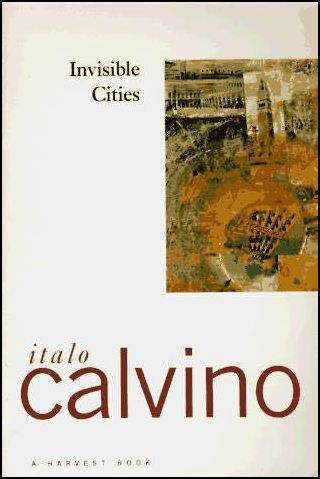
Invisible Cities


The second time I have read a book by Italo Calvino, this time Invisible Cities.  The explorer Marco Polo and the emperor Kublai Khan engage in a dialogue that has Polo describe his adventures exploring 55 cities throughout the empire of Khan. The dialogue of the two characters is rich in culture, have beautiful landscapes, diverse people, and everyday happenings.  Polo describes a skyline that offers Khan an opportunity to “see his empire” through Polo’s journeys.  The themes that Polo shares include: cities and memory, cities and desire, cities and designs, cities and the dead, cities and the sky, trading cities, and hidden cities.  Khan is an elderly emperor and these images provide some semblance of power and ownership for the land he believes he rules.  An interesting piece is that the two characters don’t seem to entirely understand each other’s language, so there is a disconnect and level of interpretation necessary from both ends.  While much of the prose creates dynamic images of the land, it didn’t paint the level of detail and scenery that got me excited as a reader.  OK, I sense the scope but what is the point?  I know many poets would say the picture painting is the point, ok then why the interspersed questions and dialogue between the traveler and the emperor?  Sometimes pictures create a better image than words.  I think I want to visit and see for myself.  Saving grace, this is a pretty quick read and of course, it is a highly regarded and nominated for various awards.  I preferred Calvino’s other read, The Baron in the Trees, another story where two characters were incapable of understanding each other.  Take a pass and read Baron.

Saturday, October 22, 2011

Neanderthal


This one has been on the list for quite some time but I would highly recommend to read it!  Neanderthal by John Darnton tells the story of two former lovers (Matt Mattison and Susan Arnot), who just happen to be rival scientists too, called by their former mentor, James Kellicut, who has seemingly “disappeared from a site” that he was doing research.  When called together, “old feelings” become active and the two are jettisoned to Tadjikistan by the US Government to help determine if the “skulls” that Kellicut sent are really active Neanderthal remains!  It appears that Russia and the US are both in the hunt to make this scientific finding, but who will get there first?  The reason for the rush is understanding the “remote viewing” aspect of the Neanderthals, who can feel your feelings as you have them and get into your mind.  There is a good amount of intrigue with captures, deaths, and rival Neanderthal groups (the good guys – peaceful, and the bad guys – the hunters).  Our two visiting scientist are caught between the two tribes and side with the peaceful tribe and try to assist in saving one of their colleagues from death.  This book reminded me in small part of the Indiana Jones stories - trying to escape the collapsing caves, trying to learn the secret language, and deal with the mad older scientist who seemingly has turned a deaf ear on the government.  All in all, it has the qualities of a thriller, though I don’t understand how they are planning to make this story into a movie, those Neanderthals are going to be ugly.  And those peaceful ones like to eat others, yes - cannibalism!   It kept me riveted throughout.  No really slow parts to it.  For those who like re-establishing the flame with an ex, answering a long ago tale of the unsolved, and a race to the end of this civilization, it’s all in here.  A good read!

Friday, October 21, 2011

He’s Just Not That Into You


OK this was an interesting “best read” from a RA, obviously it was a learning “help” book for this person.  He’s Just Not That Into You by Greg Behrendt and Liz Tuccillo serves the foundation for the movie which I can’t say I saw.  This “self-help” guide book is a series of 273 bite-sized mantras in how one should realize that you need to see and understand the signs of a potential significant other before determining if they in fact will be a life-time partner.  The authors share what is an appropriate response from a would-be partner and what shouldn’t be acceptable, do we really need a book for this?  Come on ladies?  In many respects I think this book really puts women down for not having the ability to determine how you should be treated.  For example, the authors say stay away from the following type of excuses: “he’s afraid to get hurt again,” “he just got out of a relationship,” “maybe we’re just different,” “he just says things he doesn’t mean,” "he’s been traveling a lot,” “he’s just not ready”... and so on and so on.  In the end, this series of one-liners and tid-bits women should not tolerate from their male counterpart are all common sense, or I guess what they are saying, it isn’t, hence this book!  So remember, bad guys don’t change, if a man is putting something off, he doesn’t want you, and the most important thing to remember is that “he’s just not that into you if he’s a selfish jerk, a bully, or a really big freak!”  Hmm all of this for only $10.00! Oh yeah, $13.95 in Canada.  Well the good thing is it is a “pocket-sized book” which means you could carry it in your pocket and no one will know (which is probably the way you will want it as if you need this book you probably should also be in counseling which is a better way to spend your limited resources!)  Skip it, call me if you want to know why you shouldn’t be dating this guy!  

Thursday, October 20, 2011

Dreams From My Father


Imagine getting a phone call that your father has died and you really didn’t know him… that is how this one begins, a book by our current President.  I learned a great deal about the President Barack Obama’s heritage in Dreams From My Father.  Race plays a huge role in this memoir of his early life through life after his father’s death, while at Harvard Law School.  Obama was separated from his father, a Kenyan, who decided to leave to further his education at Harvard himself.  Obama was born of a bi-racial relationship, his mother was a white woman from Kansas.  They separated when Barack was two years old and she re-married to an Indonesian student, hence his relocation with his parents to Jakarta.    He had challenges keeping up with English learning while away and eventually came back to the states, this time to live with his grandparents who had settled in Hawaii. Obama made his grandparents proud with his attendance at an elite college-prep type school.  Education played a large influence on Obama, knowing it was the key to future successes.  College life was a departure from the type of home life his grandparents provided to him.  He attended Occidental College in CA (I used to know the Director of Res Life there and he never gave me the impression it was a drug/alcohol dominated culture, hmm… good job for changing it Bart!)  That didn’t work out so well, so he transferred to the northern, big NYC college (guess which one?).  Life on his own in NY was an eye-opening experience and led him to realize his calling to help others and be in a leadership role, ah politics!  After NYC, he put his learning into action, working with churches in the Chicago area to do community organizing in an attempt to change the current crime rate and lack of family support.  The last part of the book is when Obama visits his father’s family.  An emotional visit for a man who had never met the family and land of his father yet is faced with the same issues of race experienced in his culture every day.  I really enjoyed the book and I believe it sets a great understanding for those who have never lived beyond their “one-dimensional culture."  If you live in that world, you really need to expand your world view.  While some may want to run back to “Kansas," it never will remain “Kansas” (as depicted by folks as 1 cultural view) – sorry Nick, I remember your favorite book that actually says it was two divided worlds (as will be the same for anywhere in this world now).  Obama’s story is one for the ages, role of community, family and embracing your heritage, no matter what it is.  We don’t choose our past, but knowing it helps us to know ourselves better.  Great read.  Learn something about who is running our country.  It really is important.

Tuesday, October 18, 2011

The Joy of Living: Unlocking the Secret and Science of Happiness


Back to reading “self-help” type books, or rather spiritual awakening that would help you control your thoughts, lessen your anger, and have a new approach to life.  In The Joy of Living: Unlocking the Secret and Science of Happiness by Yongey Mingyur Rinpoche, the reader gets a firsthand view of the Buddhist approach to living.  Rinpoche shares his story into Buddhism through the influence of his father and how it has changed his life.  So how do we begin?  We must first get to a complete sense of “Emptiness,” where we can gain a sense of all possibilities.  How do we get there?  Rinpoche suggests that meditation is one way to get to emptiness.  He provides techniques in the book to do so.   Remember the “ah om umm” … well practice it so you can get your breathing correct.  We need to have form and emptiness, and vice versa.  It is not purely a philosophical approach to living, though it is rooted in a strong philosophy.  For instance, a thought or feeling can't be happy or sad unless compared to another thought, so keep it free standing!  Through the Buddhist approach, suffering can be extinguished where there is an understanding through direct experience.  An important concept is the essence of time; time is not something to be fixated on.  With meditation to be successful, don't try too hard, rather change the direction of your mind; clarity changes everything and allows one to see through the power of awareness.  We need to develop a more compassionate heart where we are connected to all other living things.  The more material countries, the more suffering.  Buddhist thought suggests we do need to use our senses well; in fact there is a sixth sense: consciousness!  Being aware!   We are challenged in this approach to create a more harmonious world.  Be enlightened and learn that all is made of love.  Our bodies are not the only part of us.  As you can see there is so much in this book (a ton not even mentioned).  So why not use the approach that the author suggests?  There is absolutely nothing wrong with a positive mental approach, having a sound mind/body/spirit.  When I read the book I think of how my own father uses the power of his mind to control pain proving how powerful the mind really is.  Buddhist believes that you need a good teacher; this is so true.  It is through the power of interdependence that one becomes a member of that family.  Through thinking like this, things that bothered you will no longer do so.  This allows you to learn who and what you are, to become more open and happy.   I love this part, “Jerks stay that way because of vulnerabilities and fear.”   His final thought resonated the most, “We choose to be the way we are." The path of Buddha has one step into a new realm, an unfamiliar path which will lead us to choose to be aware rather than ruled by your unhappiness and allow your afflictions to rule over you.  If one “rests their mind longer a greater sense of calmness and confidence will pervade your being." We learn that the technique is less important but when integrated in our approach we will gain compassion and see ourselves as happier.  A very good read and learning about how to improve the struggles of day to day minutiae.

Monday, October 17, 2011

Blue Moon Mountain


It’s about that time for a kid’s book right?  Yup it is… Blue Moon Mountain by Geraldine McCaughrean.  Now I know the reason they say “once in a blue moon.”  It is only once in a blue moon that the pathway is open to Blue Moon Mountain and that is what happened one night when the little girl, Joy, was able to leave her warm snuggly bed and escape to the mountain.  During her travels she met all of the animals that we have heard lots of bed night stories about (the three little pigs, the big bad wolf, the Giant from Jack in the Beanstalk, and many others).  Joy enjoyed meeting all of them but longed for her favorite, the unicorn.  She met the whale, Kraken, mermaids, and Cyclops, but still no unicorn.  She was not afraid.  But suddenly someone screamed, “The Moon it is setting, you must leave Joy!”  The animals tried desperately to determine who would bring her back to earth, but all were afraid they would get caught “on the other side.”  Finally, the Phoenix, who always comes back from the ashes, offered to take her on the other side as he would once again rise from the dead!  He made it just in time.  But back at Blue Moon Mountain the unicorn finally arrived and asked where was Joy?  He had missed her.  So like all good unicorns, he went to Joy’s but in the process was stuck left on Earth until the next blue moon came.  No worries, Joy would hide him and keep him safe.  I thought the illustrations were circa 1950s yet the book is 1994.  They didn’t work for me, too old school.  The story, cute – like the answer to what happens when the infrequent blue moon comes.  I guess it works ok for a bedtime story.  A journey of sorts and mystical.  Kids will like it for sure.    

Sunday, October 16, 2011

Ficciones


Another anthology of short stories, this one is Ficciones by Jorge Luis Borges. This was a definite read for hard-core Lit majors.  A total of seventeen short stories which in no way are connected.  Some are a few pages and others up to about ten pages.  The entire collection is less than 150 pages long in total.  A number of the stories are his interpretation of other’s writings, capturing an earlier period of time in our world and thoughts on foreign cultures (like the Muslim world).  Borges does present some of the elements of the “human condition” and he suggests one book is contained in all books; there really isn’t anything that hasn’t been done before.  Everything is a repeat of what has already happened.  Borges’ use of language is outstanding and you need to read these over a period of time, i.e., it doesn’t sink in really quickly, at least it didn’t for me. Pretty philosophical and an acquired taste.  While I thought the language was strong, I wasn’t loving the subject matter, or maybe I wasn’t really getting it… what is it that is said, “it wasn’t speaking to me.”  And to think I was an English major… probably really should have been a “drama plays” major – right, Tisch students?  Sorry, bad form.  This was not a great Sunday morning read.  For those looking for a novel, or even short stories to pick up the book and enjoy, not for you.  If you want something to “chew on”… this probably has your name on it.

Saturday, October 15, 2011

The Pillowman


I love when I ask the Tisch acting students their favorite book as I never really know what I will get.  Even though I give months of advance warning I will ask the question, I still will get that actor who wants me to read a play instead of a book.  It’s a book, folks!  OK, ok, I always still push back but when I realize that it isn’t going to happen, I relent and say ok, what is it…  yes this was a Tisch student favorite – actors for perspective sake, read some books.  I have a whole list on the site with blog posts, you’ll get some great perspective.  And so it goes.  So today's read is The Pillowman by Irishman, Martin McDonagh.  The main character, Katurian, is in a police interrogation room blindfolded being questioned by two police detectives, Tupolski and Ariel.  Katurian, an author of over 400 short stories, is being held with his brother on the death of some people in the city.  It just happens that Katurian’s stories are very similar to the real life happenings of horrific deaths of young people in the city.  Coincidence?  Real?  His stories, which he has read to his younger brother for many years are now coming to life.  Why?  Did his brother, Michal, perform the gruesome acts?  When his brother confesses and implicates Katurian, Katurian wants nothing more than to give up his own life, but wants for his work to live on for generations.  When he confronts Michal on the indictment that he has made to the police about Katurian, Michal admits to it and to the fact that he was abused as a young boy.  Katurian kills his brother as he allegedly killed his parents, by suffocating them with a pillow.  The Pillowman story that Katurian wrote is the idea of a ghost figure who appears to children suggesting that life is horrible and only gets worse, so why not sacrifice your own life?  In the end, like his brother, Katurian is killed by the police detectives, although his stories will seemingly live on as the one detective hides them in the files rather than burns them as he was told to do.  This is a very dark story and opens one’s eye to the thinking that some have on the “glass half empty.”  Clearly there was abuse for Katurian and his brother, kids who never had joy and exposing it as a road to “salvation” for others.  Whenever I read a play I visualize it and get excited to want to direct… ah someday.  Now I want to see it on stage.  Good dark story.

Friday, October 14, 2011

The Action Hero’s Handbook


Every time I pick up another book it reminds me of how diverse the interests are in the NYU RAs.  A fun, quick read today in The Action Hero’s Handbook by David and Joe Borgenicht.  Ever want to be like James Bond, Spiderman, Clark Kent?  Well here is your chance!  The authors present dozens of “real-life” action hero responses to “tight situations” that one may be in at some point in their life… really?  Well yeah, if you want to be a superhero!  The book is separated into five sections, so you can just choose the section you might want to learn about, or like me, read the entire book!  It breaks down as follows: good guy skills (how to spy proof your hotel room and how to take a bullet); love skills, I like this one (how to stop a wedding and how to pick up someone at a bar); paranormal skills (how to fend off a ghost and how to perform the Jedi mind trick); fighting skills (how to disarm a thug with a gun and how to take a hit with a chair); and finally escape skills (how to make a clean getaway and how to navigate through a ventilation shaft).  My favorite, because heck maybe someday I want to be a superhero, was How to Crash Through a Window.  As a wanna-be actor, always thought it would be cool to jump through the window and save that lady at the end of the day!  Each suggested technique was researched and an actual expert in the industry assisted in providing the point by point technique.  For some skills there were pictures and point by point explanations.  A fun read that probably reads best while sitting on the throne in the am.  Light hearted and would make a great stocking stuffer, for those who celebrate Christmas, but at $14.95, visit half.com because I think you will be able to get a good conditioned book pretty cheaply.  

Thursday, October 13, 2011

Consider the Lobster


I think I really do enjoy reading short stories.  I finished Consider the Lobster by David Wallace Foster and said, "this is great!"  What an eclectic writer.  I’ll highlight a few of the stories so you get the idea.  In "Consider the Lobster," Wallace discusses the annual Maine Lobster Festival which brings locals out in droves.  The reader learns about the evolution of the lobster as a delicacy in the US, it wasn’t always so!  Amazing how once a market for something starts how costly that item can become.  The remainder of the essay focuses on the ethics of how a lobster is prepared.   When you really think about the options (boiling, sticking a cutting instrument in the lobster’s eye socket, or ripping appendages off), it isn’t very pretty, huh?  PETA has a field day on these treatments, I’m sure.  Wallace has the reader think twice about next year’s Maine Lobster Fest, or maybe not?  Other stories include his experience during 9/11 while at his hometown in Bloomington, Illinois and how small town folks felt the pang during the crashing of the towers.  Another story was “How Tracey Austin Broke My Heart” which chronicles the amazing rise to fame as a teenage phenom on the courts followed by her very strange series of debilitating injuries, all under the guise of “strange bad luck”.   And finally one of my favorites was "Big Red Son," Wallace’s trip to the AVN (Adult Video News) annual awards ceremony for the best pornographic movies.  Wallace captures the stereotypes of the industry, the underbelly (so to speak), and how an outsider experiences it.  Amazing how the industry is one of the largest in the world today.  Crazy amounts of money and a culture that is legitimized in so many ways by the purchasing power of the American people.  Wallace gives his own thoughts during his visit.  As you can tell, Wallace was talented and diverse in his scope of intellectual interests.  It is too bad he left this world so young.  I look forward to reading his epic, Infinite Jest in the coming months.  I’d pick this one up.  Interesting read!