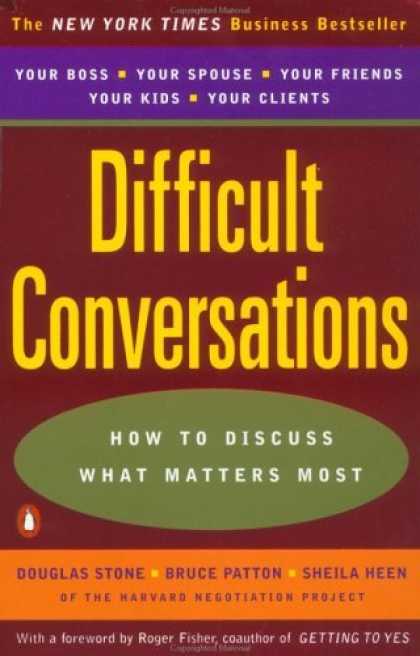
Stone, Patton, and Heen of the Harvard Negotiation Project offer the reader a “how to” handle for every discussion you could imagine, from colleagues, to partners, to loved ones in their book: Difficult Conversations: How to Discuss What Matters Most. Another New York Times Bestseller! Readers learn about sorting out a conversation before you have it, which can be helpful, I mean IS HELPFUL! It reminds me very much of Stephen Covey’s Habits, “seeking to understand before being understood.” We learn not to argue, don’t assume, and abandon blame! They present the differences between conversations based on feelings versus identity. The authors propose that our conversations should all be “learning conversations,” certainly disciples of other great teachers and author, one-time NYU faculty member Peter Drucker, the kingpin of learning conversations! The key to learning conversations as designed by the authors: know your purpose, know when to let go, how to start the conversation, and think of the conversation being told by a third party (I liked this suggestion the best!). This suggestion makes so much sense as we don’t know what information the other person is missing, and they don’t necessarily know our perspective on how we experienced what happened. They also suggest that we speak with clarity and power, reframe, reframe, reframe, and always work to attempt to have the conversation move to a place of problem solving. The authors gave some great examples. Why not spend time learning how to have better conversations? Makes complete sense to me as almost every argument I know comes after someone opens their mouth. Review your week and if you had more than two disagreements this week (who hasn’t?), read this book. A quick and great read, especially for you young communication majors!
Sunday, January 30, 2011
Saturday, January 29, 2011
A Heartbreaking Work of Staggering Genius
A National Bestseller today, A Heartbreaking Work of Staggering Genius by Dave Eggers. I read one of Eggers other books, What is the What, which I enjoyed. AHWSG, as the author refers to it, is a TRUE story told through the author’s words, his life. A sad story of two parents dying within 5 months of each other and the aftermath where Eggers himself raises, with some help from his sister Beth, his younger 8 year old brother, Toph (short for Christopher). Eggers tells the story with brilliant color and description, choosing exactly the parts of the life that illustrate the difficulty that he had raising his brother, after finishing college. He paints a picture of the “other” American family that we don’t always read about or see in the front of our media dominated culture. Eggers struggles to provide his brother with a ‘normal’ upbringing by joining Little League, participating in after school play dates, and at the same time trying to maintain his own healthy 24 year old libido by dating, etc. The journey takes the two from Chicago, then to Berkeley, San Francisco, and at the end of the book we learn they are off to NYC. It is the second book in a few days that refer to MTV’s the Real World, how weird is that. Eggers actually was a finalist for the Real World: San Francisco. Judd gets his part instead, see: http://en.wikipedia.org/wiki/The_Real_World:_San_Francisco, where he wanted to be the “tragic story guy.” Oh well. He did get to interview Judd and Puck because the MTV producer really liked him. Eggers at the time attempted to make his magazine, MIGHT, which had a double meaning, I’ll leave that for you to get the meanings. Pulling the hoax of Adam Rich’s death, which received some PR during the late 1990s, was one of the funnier things the group did. The “memoir” of Eggers is truly a 1990s read for the twenty-somethings of the day. The story was riveting and one certainly had their heart poured out for Eggers. I would say the title gave me a sense of something bigger than what I experienced. This is clearly the down and out American who wants to leave their mark on the world through laughter, excellent use of language, and using the media to their advantage. MTV is clearly embedded in almost every 25-45 year old out there, and this is further proof. Short, choppy story with flash backs and uncertainty of the next stop on the journey. A good read, but not to the hype I had heard.
Friday, January 28, 2011
The Thinking Body
I have read all types of books during this journey of trying to understand what a “favorite book really is” so one never knows what to expect. Well, this one is really weird, sorry RA who gave this to me… The Thinking Body by Mabel Todd, published in 1937. It seems pretty dated, since it is a book on… your body, specifically the bones, how they move and how to get the most out of them. Todd’s work was lauded by dancers and health care professionals (great pictures of the skeleton, how bones should move, etc.). I learned a good deal about how my breathing affects the mechanics of my skeleton and even some good posture tips. I’m thinking whoever suggested this book, must be a dancer. It is purely an anatomy book. Weird, maybe a required reading for the “science-light” dancing program, I have no idea. Is this a book I would recommend any of you reading? NO. Not even dancers. While it is a seminal work, I think your $20 co-pay to your doctor could adequately inform you of your posture and the role your approach to keep your bones in good repair. Skip this… I’ll need to see who actually said this and send them a note, REALLY? What jazzed you about this work? Getting close to only 100 books left – though 8 new RAs just hired, so thinking it may be 2-3 weeks to get under 100. All good. Reading a good one now. I’ll get it posted this weekend.
Thursday, January 27, 2011
World War Z: An Oral History of the Zombie War
Another post-apocalyptic tale, this one by Max Brooks, World War Z: An Oral History of the Zombie War. Reminded me a great deal of McCarthy’s The Road, at least some of the story line. The novel is structured as interviews (Q and As) of first hand experiences of the war. Brooks, the narrator plays the role of a member of the UN Postwar Commission. Brooks interviews people who served in the war, lived through the war, and barely escaped death. Each story gives a horrific view on the Zombies, the cannibalism, the role of religion, technology, artillery, economics, politics, and disease. Some of the stories are actually pretty engaging, while others, to be honest, had me falling asleep. I think the concept was good, though the execution was not consistent throughout the novel. You really have to be a fan of thinking the world is going to end to like this type of book. Brooks certainly has feelings about the various ideologies (isolationism, democracy, communism, etc.) and is played out as we span the globe and hear how each is affected by the World War Z. Not totally consistent as some parts of the world had the zombies and others seemed unscathed except for the weather. Highly political. Maybe timing for this read, when one thought the world was great, a SNOW DAY! So thinking end of the world didn’t seem to fit! OK read….
Wednesday, January 26, 2011
Independence Day
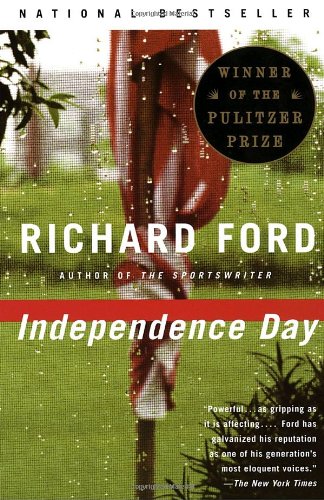
A novel that follows the life of a middle-aged guy, Frank Bascombe, a divorced father working as a Realtor. The book is Independence Day by Richard Ford. I listened to this one on the ipod. The realtor part of the story was pretty interesting for me as my Dad continues his 55th year as a realtor. So I was really intrigued by his approach to the crazy families he dealt with especially the couple that he showed over 45 homes to over a month long period, and they still were unsure to purchase. Would my Dad try Frank’s approach, blow them off after they find the home they want to move on (as a ploy to have them bid on it… but they lose the house!)? Frank’s three day struggle (yes the novel occurs over a three day period) on his role as a father to two children (his oldest died years before), reviewing his current relationship with his ex-wife and also a new flame, and how he deals with clients (renters and potential purchasers of homes). Frank seems to be going through his “midlife crisis.” Frank takes his son, who has lots of emotional issues, away on the ultimate father/son trip to the Hall of Fame. Unfortunately for Frank, his son decides to stand in front of a fastball in the advanced batting cage… you know how this goes, huh? So what did I think about a guy who seems not to have a lot going for himself, especially when he reflects on the successes of his ex-wife and her new husband, the son who he lost and the second son who is lost, and a role that is unsteady and hard to close the deal? The story happens over Independence Day, but… I think the story “Independence Day” actually reflects Frank’s decisions to be made which may lead to his Independence. A strong character development by Ford though the ending was hohum… really that’s how it ended… seemed that something else should occur.. left hanging? The real estate piece really drew me in. If not a real estate person, you may take a pass on this Pulitzer Price winner!! Wow.
Tuesday, January 25, 2011
Sex, Drugs, and Cocoa Puffs
I had high expectations for this next book based on the title: Sex, Drugs, and Cocoa Puffs by Chuck Klosterman. Was it going to be a novel on how a young teen got involved in drugs, unclear of how he would get sex or was it about the General Mills Company had a scandal while selling it’s highly popular Cocoa Puffs brand cereal? Well, got none of that for sure. Instead Klosterman presents a series of short chapters outlining 1990s media and culture issues, from Billy Joel (his angst with him) to how the Real World MTV changed how television presented itself (Klosterman really liked the Real World, even discussed how he had applied to be on the show). His presentation on Saved By the Bell, the first non-animated Saturday morning series (which I can’t believe only had 4 seasons), created the first “fourth wall syndrome of sorts” on TV when Jessie and Kelly disappeared for half of the season and returned on graduation day and we never knew where they were. His rants on music of Madonna and other 1990s musical talents (he was growing up then) attempted to make connections to what we accept and believe in as a society. He presents the evil mass murderers like John Wayne Gacy and Jeffrey Dahmer and how they were created during the 90s and aligning them to music and other media outlets of the time. This book didn’t seem to fit the title. It really is a series of stand-alone chapters that could have been editorials in Rolling Stone or SPIN magazine, ahhh this author writes for them, maybe they actually come from it. I felt like I was on an airplane and opened the US Airways monthly magazine and found a few fun “meaningless” stories about the 1990s music scene, TV scene, but not about Cocoa Puffs (which I really didn’t find big in the 1990s, for those who were alive then, did you?). This is probably a book to place in your country home’s bathroom so guests can read should they have an extended stay in the throne. Had a few laugh out loud moments, but not many. I’d take a major pass on this one.
Monday, January 24, 2011
God Is Not Great: How Religion Poisons Everything
Another lesson learned book, quite informative and provocative, looking at the role of religion in our society. Very different from Dennett’s read a few months ago, this time by faculty member, Christopher Hitchens (not a NYU faculty member!). He writes a compelling book, not in the scientific perspective like Dennett, but more a “why in the world would anyone want religion to play a part in one’s life – it has and continues to poison our world," hence the name of the book: God is not Great: How Religion Poisons Everything. Hitchens holds no religion as a safe zone. He shares examples of the “alleged exploits” of Muslims, Catholics, Jews, Protestants, Mormons, Hindu’s, the cult religions, Wiccas, etc. He tends to how the “ultra conservative” crazed members of a particular religious group will act to hurt the general population - terrorists of 9/11, ulta-protestants who killed at abortion clinics, etc. He makes the assertion that religion is “man-created” and hence we have created our own demise. He attempts to prove how religion is bad for our health (Catholic hierarchy telling its flock not to use condoms) then how religion is child abuse (forcing young teen women to be victims of savage abuse through cutting genitalia, Jewish boys being circumcised by clergy biting it off and spitting the foreskin out from their mouths), and then he moves to show how the Bible/Koran are myths/stories created by man, and not very good stories at that. He dispels miracles by Catholic saints that the Koran was borrowed from Jewish and Catholic myths. Clearly many of the points Hitchens makes are true. My take – sorry for editorial -- is that religion is flawed. My view on religion, flawed once man tries to interpret and lead others. Hitchens shows all that is wrong with organized religion. The book is compelling, though I feel it is flawed. Religion does a great deal for individuals, and who am I to judge whether it “works” for someone or not? Hitchens chooses to do just that. A super intellectual who wants to demonstrate that his examples taken together proves the point, who needs religion. Hmm… lots of people need it, and actually thrive because of it. If nothing else, a really on target view from a non-believer. Worth a read to reinforce or challenge your beliefs.
Sunday, January 23, 2011
The Last Lecture
Another book in which we learn about life and a few good lessons, this time by a dying man. The Last Lecture by Randy Pausch, a faculty member of Carnegie Mellon. The concept of the Last Lecture, for those who don’t know, is a program that is offered on many college campuses by offering members of the faculty to come to a res hall, a dining hall, or even a classroom auditorium and choose a subject of their choice and give a one hour lecture and present as if it is their last. Well, this is his last lecture as the 47 year old Pausch has been diagnosed with Pancreatic Cancer and wants to fulfill the request he received prior to the last diagnosis, to present his “last lecture.” If you haven’t seen some of the video, Oprah has a reprisal of the lecture… http://www.youtube.com/watch?v=BODHsU3hDo4. The book is the background and shares many of the lessons from the actual speech. We travel through the lessons learned and shared by his parents, coaches, teachers on his journey, and those he has learned from his students and three young children. What a wonderful gift to provide a book of what you want to have your children value and learn, and written by your father. What a beautiful gift that Randy Pausch gave to his kids. The main messages are don’t take life so seriously, live every moment, teach others something, and love… and all of these lessons come through clearly and emotionally. Sixty lessons shared and worth the read. You may shed a tear or two as you go through the pain and despair most of us would feel, but from Pausch he isn’t only realistic, he is positive. What a role model he has played for those with any terminal disease. This is a short read, profound, yet simple. Who says you need a long book to impact us… reminds me of Tuesday’s with Morrie but the focus is not Mitch Albom (the author of that book), but his children... and yes I understood the “head fake” Randy. We all need to! Your impact is still felt today, no doubt!
Saturday, January 22, 2011
The Art of Racing in the Rain
A really good book with a major flaw… The Art of Racing in the Rain, by Garth Stein. I really loved the concept of the book, having just joined the ranks of dog ownership, I thought having the “man’s best friend” being the narrator of the story was brilliant. The story, during the short life span of a dog’s life, is about Denny Swift, a race car driver who experiences the death of his wife, Eve. Eve is diagnosed with a brain tumor after the birth of their daughter. Enzo, the dog, narrates all that he has learned during the tumultuous days of Denny’s marriage, birth of his daughter, the dying days of his wife, and then the downward spiral following Eve’s death. Eve’s parents choose to sue Denny as he has always been more absent, trying to secure a spot in the racing circuit. Things get ugly after Denny’s fifteen year old niece, Anika, accuses him of rape. Denny goes through all of his money (Eve’s parents are loaded and drag out the process trying to take all his resources away). Of course, Enzo knows that Anika's allegation is a lie, he was there and she actually tried to take advantage of him – a longer story, you should read. I was all over this book until one part… near the end, when Enzo (the dog!) is called to the witness stand to prove Denny’s innocent through the use of a voice machine! UGH! You really had a great book until you used this technique Mr. Stein. There certainly could have been another way, even having Anika change her story… The story was very engaging and again had some nice lessons to be learned. Interesting two days in a row reading death journeys – read Last Lecture tomorrow. I can see how this one was a New York Best Seller. A relatively quick read, though I actually listened to it! A nice stocking stuffer/gift for a friend or family member. Read this one!
Thursday, January 20, 2011
Kafka on the Shore
Another "second time around" author from the list. This time Japanese author Haruki Murakami. I actually felt this book was much better than the first book I read from him. Kafka on the Shore tells multiple stories, a very unique and interesting writing style, to be honest, by having the odd chapters follow the life and times of a 15 year old runaway, Kafka Tamura, and the even chapters explore the life of Satoru Nakata. Nakata was subjected to an end of WWII freakish “light striking from the sky” incident that had him lose many of his mental faculties, though he didn’t seem to lose his strength. The tales interweave, with two very different people and moments in time, a connection as Tamura’s father is killed by Nakata. Murakami blends in unusual characters with a return of Greek tragedy, aka Oedipus is back! Tamura fantasizes about a prophecy that his father shares with him in his youth, you will sleep with your mother and sister and kill your father. Though he is raised by his father, his mother and sister leave the home while he is 4, without reason. Through his journey of fantasy/real life intersections, he finds “his mother” and a “sister” figure, or are they really them? Murakami is also personally fascinated with youthful sex, read Norwegian Wood, which is much more explicit. His character portrayal of Tamura reminds me of Holden Caulfield, running away from his reality and exploring sex and all other things a young teen often thinks about. Murakami does an excellent job as author bringing the multiple intersections of human proclivities and fears together using the influence of music, gender roles, and societal good/evil all into this rather captivating story. The depth and levels of human understanding and complexity are all within this tale. I rate this fantasy (is it real?) book pretty highly. Just added another one of his books on my audio player for the next few weeks. We’ll see.
Subscribe to:
Posts (Atom)