Tuesday, May 31, 2011

The Tender Bar: A Memoir


I love journey of life stories, today’s no different.  J.R. Moehringer presents his real life memoir, The Tender Bar and I have no doubt it will be a classic (high schoolers are reading it already, on my son’s shelf!).  The story is the tale of J.R. growing up in a single parent household, mother left the father after he almost killed her.  J.R. and his mother went from Grandpa’s house to Arizona and back again.  J.R. eventually stayed in Arizona during his school days and came to Manhasset during the summer so he could be around males, particularly Uncle Charlie.  J.R. shares the lessons learned around Uncle Charlie’s friends from the bar where he was the bartender to the various other males who played some part in his upbringing (Bill and Bud are two men who ran a bookstore and hired him at age 14 so he could assist his mom in providing for meals and rent).  The two men at the bookstore taught J.R. the importance of reading – this is THE lesson every person needs to gain in their life.  Where are we without stories? And lessons learned?  Bill and Bud also allow J.R. to dream and dream BIG.  They convince him Yale is the place for J.R., where he does apply and gets a full ride to attend.  We read about the disparate worlds that exist at Yale, the kids who have been “groomed as Yale kids” and those who get to Yale despite their meager upbringing.  J.R. is challenged academically and almost quits for a number of reasons, but somehow manages to make it through.  He falls in love with a rich, older Yalie.  It becomes an on-again off-again relationship.  Each time J.R. losing emotionally.  J.R. keeps returning to Manhasset and the Publican bar, Uncle Charlie’s place of employment.  A place where Steve, Cager, Bob the Cop, Joey D., Smelly, Dalton and others all impart some part of wisdom and real life examples for him.  J.R. has a few encounters with The Voice, his Dad, who he immortalizes over the years.  His Dad was a radio guy and he randomly finds him at different points in his life, usually on the radio doing a show.  As J.R. graduates from Yale he works at a department store before he has a meeting with Sidney, his Yale love, who suggests he writes for the NY Times.  He applies for their training program and is hired.  He continues to be attached to Sidney, but she breaks his heart too many times before moving on.  J.R. is always drawn back to the Publican bar and plans on writing a book about it, THIS BOOK!, and gets support from the guys.  There are a number of turning points in his life: love, death, people who inspire him (Father Amtrak, his cousin McGraw, Jimbo, Michelle, and of course his mother), and September 11th.  The book actually comes to the close eleven years later when September 11th occurs and J.R. is brought back home to face the death of his cousin and the loss of over 50 lives from his hometown, Manhasset.   J.R. brings the story to conclusion with what he does for others, his last standoff with his father, and finally noting the role of the woman in his life, his mother.  Heartwarming read of someone whose disillusionment doesn’t seem to get the best of him, though I know his journey continues.  Nice to read a book on a journey of someone who was born the same year as me… maybe I should write the book that is within me?  I can see why this was a bestselling book.  Good read. 

Sunday, May 29, 2011

Art As Experience


Tough reading a philosophical view on Art!  Yes, a 1934 version.  This one by John Dewey, who I haven’t read since I read his work for my dissertation.  Never thought I would be reading Dewey as part of the RA Favorite Book Project, but alas, I have! Art As Experience presents Dewey’s collection of essays on aesthetics that he presented while at Harvard.  Dewey suggests “what is important” in the physical manifestations in what he calls “the expressive object” and later details the “process of experiencing art.”  The chapters include a discussion on the creative process, the experience the “art creator” has and how different it is than the “art experiencer”  (i.e. the person who is actually viewing art), the organization of energies, “the human contribution,” and finally how art has changed during our civilization.  It is a dense book, for sure.  For those interested in the study of art, this probably serves as one of the foundational books necessary for your studies; for those in philosophy, certainly can be helpful; for anyone looking for pleasure reading, this is not it.  Dewey shares his “hierarchy” of the art forms…. Guess which one?  Could it be music?  He does give an overview of how the human sensations are changed through the interaction of art.  When reading it is interesting to how applicable his theories are to the reader of today.  Just illustrates how smart Dewey was… love this guy!  Wish I was that smart!  Tough read on a gorgeous day in PA sitting by the pool.  Lucky the water in the pool was cool to keep me refreshed.  

Saturday, May 28, 2011

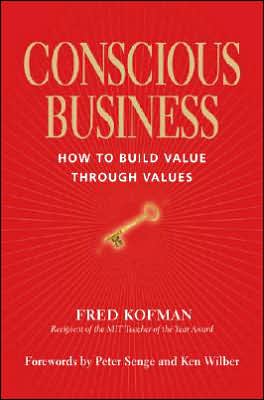
Conscious Business


I always enjoy reading business books, knowing that this must have been required reading for one of the Stern courses!  Conscious Business by Fred Kofman, a former MIT faculty member, provided an outstanding read on building values driven organizations.  Kofman’s book starts with introductions by some of the best educators in the field of organizations, Ken Wilbur and Peter Senge (one of my favorites!).  Kofman presents strategies and examples of how organizations need to be driven by a set of values that respects and honor others.  He weaves in great fables/stories that further illustrate his points.  Kofman also presents real life examples that include dialogues (and even fixes them to further demonstrate how to better the conversations). He also shares stories taken from Jim Collins' Good to Great, an all-time favorite!  Be conscious of your conversations and interactions with others is rule #1.  The three dimensions of business: the task, the relationship, and the personal.  He then explains the integral perspective of an organization: product (having), process (doing), and platform (being).  Once you understand the process of business, one can then move to create conscious attitudes, which include: unconditional responsibility, essential integrity, ontological humility, conscious behaviors, authentic communication, constructive negotiation, impeccable coordination, conscious responses, and emotional mastery.  Each chapter is one of the tenets listed above and the final chapter brings it all together by entering the market with helping hands.  One of my favorite stories to illustrate his point occurs when he is on an airplane with his children and they suddenly jump out of their seats during the flight.  Instead of yelling at them, he remembers, if we were to crash would I want my last memory to be yelling at my children.  This reminds me of the simplistic thought of how we should treat people as we never know when our last moment will occur.  He uses a great deal of Christian thinking and role models in his examples.  He also quotes Victor Frankl (if you haven’t read his book on being in a concentration camp detainee in Nazi Germany, Man’s Quest for Meaning – ADD IT).  Let me share one last great story that Kofman uses:  A big tough samurai once went to see a little monk.  “Monk”, he barked, in a voice accustomed to instant obedience, “teach me about heaven and hell!”  The monk looked up in the mighty warriors and replied with utter disdain, “Teach you about heaven and hell? I couldn’t teach you about anything.  You’re dumb.  You’re dirty.  You’re a disgrace, an embarrassment to the samurai class.  Get out of my sight.  I can’t stand you.” The samurai got furious.  He shook, red in the face, speechless with rage.  He pulled out his sword, and prepared to slay the monk.  Looking straight into the samurai’s eyes the monk said softly, “That’s hell.”  The samurai froze, realizing the compassion of the monk who had risked his life to show him hell! He put down his sword and fell to his knees, filled with gratitude.  The monk said softly, “and that’s heaven.”  Add this one to your list, especially those who work with groups!

Friday, May 27, 2011

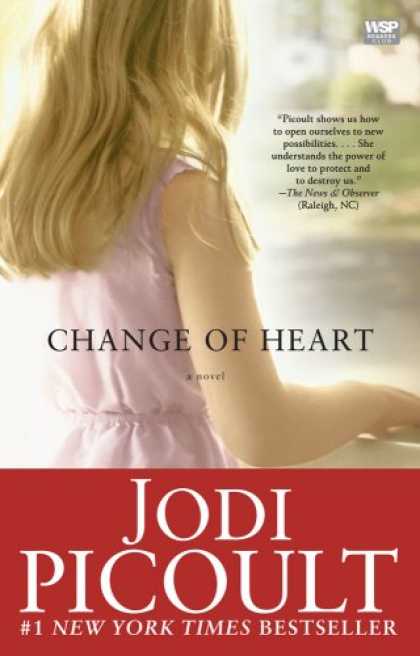
Change of Heart


Finally finished listening to Jodi Picoult’s Change of Heart.  Can anyone really endure that much personal pain… the story begins with the death of June’s husband in a car accident that barely allows June and her daughter Elizabeth to escape.  June’s life seems back on track after she marries the policeman, Kurt, who told her the news of her husband’s tragic death. Some years later, while pregnant with the couple’s first child, June comes home to find police all around her home and both Kurt and Elizabeth are murdered, presumably by Shay Bourne, a handy man who was doing work in the house.  The trial for the murder concludes with Shay Bourne receiving the death penalty, the first in New Hampshire in over 65 years.  Now the story really begins!  Leave it to Jodi to throw her readers into a maelstrom of activity before chapter three occurs.  I am really glad that I listened to this story because of the “device” that the author uses is the voice of the main characters, June (a woman who has gone through more than one could ever hope!), Michael Wright (who served on the jury that convicted Shay Bourne AND becomes a priest – and later the spiritual advisor to the murderer), Maggie Bloom (a pip! She is the ACLU lawyer who decides she wants to save Shay Bourne), Lucius DuFrense (Shay’s next door cellmate in prison), and finally Claire Nealon (the second daughter of June who will later learn needs a heart).   There are few stories that are as intricate and connected as this one.  Everything you learn at some point in times comes back to serve a purpose.  During the trail, Michael is the hold-out in convicting Bourne but is eventually swayed to change his vote, which is a driving force in his initial guilt for helping Bourne.  Maggie begins her desire to help Bourne as it could serve as a catapult for her to receive the recognition she so desires.  Lucius, an AIDS patient in jail for killing his lover, takes a liking to Shay when he thinks he has some sort of powers after Shay “performs” some miracles in the cell.  Finally all comes together in the story when Shay sees on television that a young girl, Claire Nealon, who was born with a heart ailment, is in need of a heart.  Shay realizes he can give back to the family that has been ravaged by tragedy.  When June is contacted by Maggie and (now) Fr. Mike, she immediately refuses, but she knows that this may be the only hope for her second daughter to live.  There are so many levels of stories within stories and issues within the plot: death penalty, prisoner rights, mysticism/faith/miracles, ethics – do you take an eye for an eye?, forgiveness for your past loses, and the list goes on.  I think the author does a masterful job of weaving these together and then the shocker occurs… Shay may not have killed Elizabeth and Kurt intentionally, AHHHH… I will not divulge the secret twist in the blog as it is worth finding out.  Will Claire receive the heart?  Will the state of New Hampshire change the manner in which Shay will die to preserve the heart for Claire?  Will Maggie ever have a date?  I’d add to the list.  Was number #1 on the New York Times Best Seller list and probably deserved to be.   Listening to this one worked very well!  Enjoy. 

Tuesday, May 24, 2011

How to Talk to a Liberal (If You Must)


I am not an angry person, nor a person who needs to argue every issue to prove I am right, no matter how small or large… yet I just finished reading a book where the author is not only arrogant but redundant (over and over again!).  I also need to say I do not consider myself a liberal nor a conservative, for which many may say, ah he is wishy-washy on the issues, no I don’t think so.  I think poverty and lack of education needs to be resolved, war should be avoided unless imperative (I guess that is a “cop out” answer too), and something needs to be done about healthcare, self-interest groups, and of course equal rights across the board.  I found Ann Coulter’s book How to Talk to a Liberal (If You Must) far beyond “throwing daggers” to make her points that she is “holier than thou.”  To be honest, I had heard of her, in fact I've seen her once or twice on one of those nightly political talk show discussions.  I thought, very attractive but boy is she overly opinionated.  It wasn’t until I read the book that I understood why people really disliked, or loved her.  The book is a series of her columns that have been published in other periodicals or on-line during the 1990s – 2004.  The funniest thing to me was, darn, she is an alum of my nephew Harry’s college, Cornell!  Boy must he be happy…. NOT!  I had often heard Harry scoff about Coulter’s indignations and other political “wrongness” – certainly she would be in another stratosphere if I had used the word “correctness.”  The main issues the book addresses include “why are we not screening Arabs when flying after 9/11,” “George Bush is our savior,” every Democrat is either a liar, drunk, killer, or Ku Klux member… you get the idea.  She even notes in one column that Osama Bid Laden had been killed through one of the operatives that occurred under the leadership of President Bush (2004).  She had a field day with proving her legal prowess on the hanging chad of the 2002 election in Florida.   Must I go on as she did?  More air time might actually interest some to read… oh I forgot, attack of Al Franken and the Hollywood stars… ok, I’ll stop now.  Is it really that important to try and prove you are always right and everyone else isn’t?  If you like that premise for a book, you will love this book.  I didn’t at all!

Sunday, May 22, 2011

Lone Survivor


The real life story of Marcus Luttrell is today’s “audiobook” – Lone Survivor-- as we road back and forth to PA this weekend.  The story begins with Luttrell’s decision to join the Navy and then to join the Navy SEALs.  Luttrell talks about the pain staking process of the weeks of “hell” that candidates for the SEALs must endure.  It is all about the mental, as many of the toughest and strongest could not endure the mind-numbing activities that the future SEALs must face.  The stories are excruciating, being shot in the face with freezing cold water carrying a boat over your head in sub degree weather or jogging for miles each day with boots and full gear on with little to no water, etc.  Why do they do it?  Luttrell gives a really heart-warming (if you can say that) tale of why and his love for this country and love of God.  After his successful entry into the SEALs, Luttrell is sent to more training and eventually is called into action, right where the story begins, on June 28, 2005, as Luttrell and SEAL Team 10 were assigned to a mission to kill or capture Ahmad Shah, a high-ranking Taliban leader responsible for killings in eastern Afghanistan and the Hindu-Kush mountains. Luttrell’s teams is asked to go out into the territory and are faced with some goat herders from the region and are confused as to what to do with them, kill them or let them go?  (We learn in the book the rather difficult role the armed forces in the region have when determining what to do.  If you kill someone, the locals will go to the media and say – those Americans are killing our innocent people, if they don’t the “innocent people” could end up being informants of the Taliban and will get the armed forces killed).  Luttrell and his team made up of Michael P. Murphy, Danny Dietz, and Matthew Axelson make the wrong decision and the herders contact the Taliban.  The next four days are described in detail through Luttrell and he alone remains alive while his three SEAL team members are killed.  It is a story of heroic proportions. Luttrell speaks freely of the role that God played in allowing him to survive in a “I can’t even believe this is possible” story.  The story was like watching multiple stories from the TV show “24” but better as this is true life.  I just found out that this will be made into a movie, which will probably be one of the few books I have ever read that I think could make a good movie.  This is a definite read book that tells the harrowing story of the guys who protect our country.  Whether you are pro or con military this book illustrates the craziness our armed forces face and should remind each of us we better have some strong support for our guys when they return!

Saturday, May 21, 2011

Astonishing Splashes of Colour


Another modern novel, this one by Clare Morrall, is Astonishing Splashes of Colour.  Set in Britain, this is the story of a young woman who is confronted daily by the losses she has faced in her life, though some losses didn’t really happen (ah the twist in this one is pretty good, though I figured it out before it was exposed).  Katherine, who picked up the nickname “Kitty” after the family kitten died, is in a state of depression largely untreated and lives next door to her husband, James (the nicest guy in the book for sure!).  Kitty is the youngest child in her family, a family of six, though she never met her mother nor her oldest sister, as mom was killed in a car crash and sister Dinah disappeared with some hippies at age seventeen.  The four older brothers served as baby sitters for the young Kitty as her Dad constantly was consumed with his paintings, an artist by trade.  Her brothers all are now consumed with wife and kids, girlfriend, work, or some other distraction.  Each of the brothers want what is best for Kitty but realizes she needs professional help.  Early on in the story the reader learns how Kitty goes to school each day waiting for her son Henry, though Henry was never born.  Kitty lost her pregnancy pre-maturely.  Death and disappearance play a major role in Kitty’s inability to feel a sense of stability.  Kitty moved out of her father’s house in her late thirties and that’s where she meets James, the son of two doctors, who has his own issues (physical and emotionally).  The story follows Kitty’s strange adventures living in another world where she has premonitions and has a hard time of dealing with what is real and what is imagined.  The story comes to the major twist after Kitty’s grandparents are found died in their home (of natural causes) which leads the family to reunite for the funeral.  What a series of learnings… all leading to Kitty’s abduction of a child in a hospital and then stealing another child, a seven-year-old brat, who tries to pawn herself off as a bratty thirteen-year-old.  Kitty finally faces the lies that were created about her life in the final pages after the young seven-year-old burns down Kitty’s father’s house.  I wish the author had used a bit more on the whole “colour” piece which is only touched upon but makes so much sense in the area of depression.  The scenes with Kitty and her counselor are real and give the reader the belief that treatment can be a source of support when all else seems to be going out of control.  I really enjoyed the story and believe the author did an outstanding job of presenting characters that were real and believable.   While this story too jumped around (like yesterday’s) I thought that it was much more connected. Add this one to the collection.

Friday, May 20, 2011

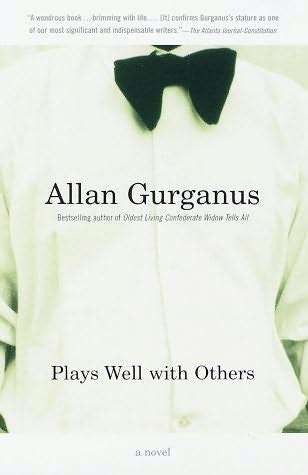
Plays Well with Others


Sometimes when you are reading a book you say to yourself, “I get it, but I don’t love it”… so it goes with Plays Well with Others by Allan Gurganus.  The story is set in the early 1980s – mid 1990s during the height of the AIDS epidemic in NYC, also during the high end of the sexual revolution of sorts.  The story focuses on the protagonist, Hartley Mims Jr., a writer, and his two newly acquired friends, Robert and Angie, both of whom are in the art world too.  Mims has relocated from North Carolina and is looking to find a place that makes him comfortable, as are most of his gay friends, who have left Iowa, California, etc. to be freed in NYC.  The problem is, the freedom includes unprotected sex across genders and at all the places one can find it.  The book is really a series of short vignettes about the three characters' lives, mostly on Hartley, though the real through line is the demise of the beautiful Robert Christian Gustafson, the son of a preacher, and how Hartley has to bury him and so many other friends during this timeframe.  The short stories paint Hartley as a more reserved young man who has to keep the young Asian middle school boy who he tutors at bay (he has a major crush on Hartley and actually tries to make a sexual advance – which is actually pretty comical).  Gurganus weaves in personal tragedy, comedy, and self-reflection in illustrating how utterly difficult these times were.  Hard to imagine that was only 30 years ago…  The story is compelling for those who were not aware of the hate and bigotry infected gay men were treated with during that time (though I would say I’m sure those feelings exist to this day).  I guess I never warmed to the characters of Robert or Angie (wasn’t really sure what she was all about)…   I’m glad I read it, but would not say one of my favorite as the short vignettes and jumping from one time to another didn’t really flow for me.  I’m not completely linear, but I’d say format was ok. 

Wednesday, May 18, 2011

The Audacity of Hope


What a great book to finish listening to on NYU Graduation Day where Bill Clinton was the commencement speaker, Barak Obama’s The Audacity of Hope.  Obama’s book follows the rise of his interest in politics, running for various offices, and his thoughts on so many things.  There are a few personal reflections on his own family background and his falling in love with Michelle, his wife.  Honestly, how can anyone NOT agree with his stances on almost anything from family, to religion, to role of government, lobbyist, energy consumption, global warming, international borders and the challenge the borders present, health care, and how we all need to listen before acting.  I loved the friendly barb of Ann Coulter too.  The challenge between Democrats and Republicans was aptly described and with some insight as to how to move forward.  The inner workings of a Senator’s life on the Hill and personal struggle to maintain family balance provided a truthful perspective on why the personal life usually fails for our politicians.  The reader learns about the campaign trail, how our constitution was created and lives on today in the chambers in DC, how values should always play a role in our society, and the opportunities that stand before us.  The book was published in 2006, well before the Presidential campaign, and I can see how it served as a venue to clearly understand Obama the candidate.  Not having read it then, I probably should have done so.  It makes me happy to have a President who not only writes eloquently but stands for something, in fact, many of the things I believe in.  While I am not advocating a republican or democratic point of view on the blog, or in my professional life, I am advocating for education and learning… and yes reading is one of the MAIN ways to do so.  I challenge all of you (myself included) to read the work of our politicians.  Learn what they stand for by what they WRITE.  On a day like Graduation Day at NYU, I reflect on Obama the faculty member at University of Chicago’s law school and say, yes! We need more educators as politicians and less politicians as politicians.  Knowing what you believe in and then taking actions based on your beliefs is a sign of the mature person, a person of character.  If one wants to know how our President thinks, you should read this.  In fact, shouldn’t all Americans?  I think we owe it to ourselves to know what our leader believes in!  Add this to your list.  I wish I had a few years back!  

Tuesday, May 17, 2011

The Gunslinger


The Gunslinger by Stephen King is the first book of his Dark Towers series.  The story follows the life of the lead character, the Gunslinger (Roland), and his journey to find the “tower” and its meaning.  Roland is the last living descendant of the knightly order of Gunslingers.  The book is a sci-fi/western style story mixing genres and is placed in the “old West” mentality where shooting others and seeking revenge are paramount, as is finding the missing secret. During his early travails, he runs through a village in the outskirts of the desert and kills a village in pursuit of the “Man in Black” who evades him for the vast majority of the book.  The Gunslinger stops along the desert and meets a man who exchanges information about the Man in Black but provides little answers, only more questions.  Roland is also unsure of whom to trust and who may be the enemy, though he knows the Man in Black is the enemy of all enemies.  Later in his search he meets up with a boy, Jake, who serves as a younger brother/son for him.   The two continue the search and are always one step behind the Man in Black thinking they just might actually find him.  The search takes them on a ride through the mountain on a handcart being chased by some type of skeletal creatures where Jake is in fear for his life at every moment.  The first book of the Gunslinger concludes with a confrontation between the Man in Black and the Gunslinger.   Having only read the first book of the series (which I hear goes for seven books in total!), there are clearly questions unanswered.  Hard to respond completely to how good or not so good this book is as it really only scratches the surface of Roland’s journey, but one can’t deny King’s ability to tell a story, that’s for sure!  He is one of the great writers of the weird, the watch out around the corner, and finding multiple meanings within a story.  If anyone else has read the complete series, please post a comment on this one.  I’ll reserve final judgment until the day I read the final six books!