One person can help change the world… so says the man who left Microsoft to change the world, in a book called: Leaving Microsoft to Change the World. Reminded me a great deal of Paul Farmer’s work in starting a non-profit when he clearly didn’t need to do so. Lucky for us, people like John Wood use a “rich man's" trip to the Himalayas to realize “hey, can’t I do something to stop illiteracy in the world?” The book chronicles the true life story of Wood and how he comes to leave a lucrative life of personal driver’s, million dollar apartments, jet-setting around the world, and working 16 hour days for a life worth living. Hurray for Wood and Farmer. The new role models for the twenty-first century. Wood's story gives us hope that many of the Sternies of the world will find their rainbow of yachts, tennis matches in their back yard, and all the money you could imagine may actually not be fulfilling. And to think, all the profits of this 2006 book go to his non-profit, Room to Read (from the website… “Room to Read is opening its 10,000th library this year and they impact the lives of 5 million children in the developing world."). Nice read, though Farmer is a bit more interesting since they seemed to face a few challenges. Wood makes it seem if you have passion and energy, you can do this too. I gotta believe there were a few more challenges along the way. Also should have finished up with a better “thank you Dad” after dissing him a bit in the early parts of the book on how awkward their relationship was. For all his Dad did in cultivating his dream, he should have given him a larger thanks, in my humble opinion. Dads always seem to get the short end of the thanks from their kids…. Not on the top of my list, probably second of third tier book.
Sunday, October 10, 2010
Saturday, October 9, 2010
The Color of Water
Life can throw us a curve ball, if we allow it. In The Color of Water by James McBride, Rachel Deborah Shilsky aka Ruth McBride Jordan, mother of 12 children, born a white, Jewish young woman, faces life on the move during her early years and then grows up in Suffolk, Virginia, working for her abusive father as a store clerk while attending school. Rachel, who changes her identity when she leaves home, is exiled from others because she is Jewish in “WASP” country. Her only refuge is to fall in love with a young black man from the area. She gets pregnant, is sent away to her mother’s family in NYC, has an abortion and begins to be born as a young woman. When she returns back to meet with her “first love” Peter, it is learned he has impregnated another young girl, this time a black girl, and Rachel is devastated. Though she has the pull to stay and help her crippled mother and her younger sister, she cannot bear to stay around the physically abusive father, a town griped in racial strife, and not having a life of her own. Rachel “dies” in her family’s eyes when she marries a black man in NYC. Ruth, as she is now called, marries a staunchly religious, albeit, Christian man who helps her to find peace in Christ. The most interesting piece to this beautiful true life story, is that each chapter is written from two perspectives and finally intertwine at the book’s conclusion. James, the protagonist, is writing the even chapters, while reading a letter from his mother in the odd chapters about her life, something he did not learn about until he was well into his twenties. James McBride is a former journalist (this story in fact is a great example of his work trying to find the story and replay his mother’s other life prior to her marriage to his father). Additionally, he has written music for famous singers like Anita Baker and Grover Washington, Jr. His family story is amazing – how a poor family (with a white mother and black father, who dies when James is 8) struggles to succeed day to day, yet through the encouragement of a mother who is committed to education, has all 12 children graduate college (and then some!). What a wonderful heroine for all women to aspire in Ruth McBride who never seemed to fear the color divide in a time that the Ku Klux Klan rules the area in the late 1930s. Two days, two great heroines! Read the book. Great read. And oh yeah, James McBride…Distinguished writer in residence… NYU! Wow, isn’t that cool!
Friday, October 8, 2010
Jane Eyre
Being sick has its benefits; well only one, reading a good book or 3! What makes a good book anyway? Sometimes a classic that sets the foundations to be copied, sometimes a true life experience, and sometimes overcoming challenges and making this world a better place. This weekend I read all three types of books. But for this entry I’ll focus on the classic, Jane Eyre by Charlotte Bronte. The book is broken into five parts – Jane growing up with her rotten to the core aunt (can you say a precursor to Cinderella?). Her aunt sees Jane as competition to her children and eventually needs to go away to a boarding school to get away from the abusive situation. Jane goes to the Lowood School (where she again finds pretty horrid social conditions and actually physical conditions as well as her friend Helen dies of consumption due to the lack of heat in the facility). In the next phase of her life she goes to Thornfiled to become a governess (after a few years of moving to the teaching rank at Lowood). I believe Jane Eyre’s next three sections serve as the true beginnings of the “romantic novel” of today (you see it time and again, “The Sound of Music,” almost all of the Disney romance cartoons, and certainly the cheap $5.99 trashy romance novels on the market.). Jane is employed at the home of Mr. Rochester (who is on the road often) and ready to marry a rich woman when he realizes his love for Jane, proposes, and then all heck breaks lose. I won’t go into the detail as it is a series of “no way this is going to work out.” I bet you guess what happens in the end? You’ll need to read this one. So much better than the other classics, I just couldn’t get into like Pride and Prejudice, etc. This one is really a precursor to the love stories of Nicholas Sparks. Nice ending, Charlotte! Read it if you haven’t had to for AP English.
Thursday, October 7, 2010
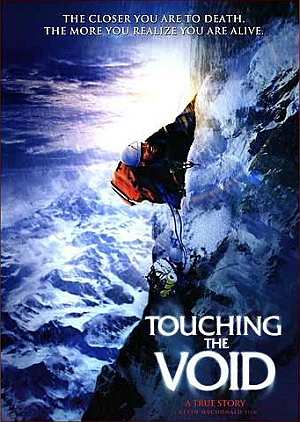
Touching the Void
I’ve read a few of these real life, over the top books before, so Touching the Void was more of the same, though with this one it was 2 climbers and not a group. Additionally, this one didn’t end in tragedy like Into Thin Air. I guess as someone who is afraid of heights, I just don’t get it. Climbers I speak to speak of the “high” one gets hanging from a cliff looking at the beauty of the scenery. Not having that beauty in the book, it’s even harder to get through. While the story is griping, never understand the “why”… This story related the experience of two climbers (Simon and Joe) who experience a near death at the 6,344-metre (20,813 foot) Siula Grande in the Peruvian Andes in 1985. Two climbers who get separated through a “cutting of the chord” on their descent of the mountain. One climber falls down into a huge crevice in the mountain, breaks a leg, but escapes the next day and heads down the mountain, three days without water or food – (it is a truly amazing reflection of how the human spirit can survive!). There is the obstacle of “losing his mind” as he nears the campsite, but he manages to make it. The other climber descends feeling his comrade died on the mountain, unsure of what he will share with his family and friends. The story gives both men’s perspectives, one thinking he is dying, attempting to come down the mountain, while the other on his way down (and later at the campsite with another climber), feeling his loss of his friend from the mountain. In the end a joyous reunion occurs, shouldn’t all stories end this way, especially for people who create the tragedy. Sorry, not a great deal of sadness for me. (Sorry climbers, not trying to have you tee off on me…)
Wednesday, October 6, 2010
The Contender
I read a nice story today, The Contender by Robert Lipsyte. The message, pretty simple, find a goal worth fighting for and you can contend against anyone, including yourself. Great message. The character development was the weak piece. The author cut corners in the development of the relationship between Alfred and his friends. It was almost like watching an abridged movie or an After School Special, remember those days, you “Tom’s generation folks” – certainly not something they show today. This was a very weak read, probably too quick. Wanted more in the change that took part in Alfred, much more. So here’s the abridged version of an abridged story… Alfred (protagonist), a young black man, grows up in tough neighborhood in NYC – quits school, in a bad crowd, finds an escape (the local boxing club), the trainer befriends him, challenges him to box, he does, wins a few matches, challenged more by bad crowd, fights last fight where he “sees the light”and finds a passion in his life (he is a high school dropout with limited future), befriends the bad crowd kid. That’s it folks… Again, great message but cuts the reader short in lots of ways. The message is worth the read!
Tuesday, October 5, 2010
Gypsy
Tisch students (our acting school) always want to provide a favorite play as their favorite book. Last year I was somewhat open to it. This year, not so much… so I finished a “last year” favorite tonight, Gypsy, yes the Broadway musical. While plays are, for the most part, pretty quick reads, it is much more difficult with a musical (you miss all of the extra pieces needed to get the whole experience, i.e. Ethel Merman singing “Everything is Coming Up Roses”… just not the same reading it). I’m sorry but I just don’t think a play is a favorite book. Actors, broaden your horizon and READ BOOKS. It helps with character development, et al. Reading books as much as I have over the past two years has been the single best thing I have done for my spare time in adding perspective about life – the good, the bad, and all in between. I would not add this “book” to your list. Seeing the play? I missed seeing it with Bernadette Peters when it was on Broadway in 2003, oh well. I forgot to talk about the story… go catch it next time on the stage, the music is better than the story… vaudeville, burlesque - which is better? Neither are "in" now. Back to some book reading…..
Monday, October 4, 2010
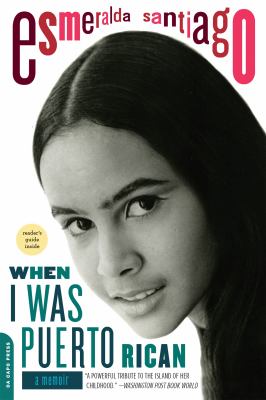
When I Was Puerto Rican
Sunday, October 3, 2010
Sphere
From financial planning books, to kid classics, to sci-fi! Today’s read was Michael Crichton’s Sphere, a sci-fi/psychological thriller. Norman Johnson and a team of experts are called to assist in examining an “alien spacecraft” that lies at the bottom of the Pacific Ocean. Much to the scientists' surprise, not until they are actually down there do they realize, wow this isn’t alien… it’s an American-created craft that was created 50 years from now! During the trials of this thriller the crew meets a mysterious spherical object that confronts them and leads to the last standing to face their own fears. Since you have some of the smartest scientists and of course psychologists, they get to communicate with the sphere, well kind of since it actually starts to control those who entered it. In the end, psychology beats out science and Norman and his two colleagues give up “the power” they receive from entering the sphere. Sci-fi is not my favorite type of book, but you know what, I am enjoying it more and more. Crichton, best known for his work with Jurassic Park, creates a believable thriller with characters who are interesting and who face the scientific challenge that means create. Well done. I would add to the list. Starting to change my mind on these sci-fi books. Good read!
Saturday, October 2, 2010
The Lorax
Just finished meeting the last of the new 174 RAs yesterday. What a great group. In all, 65 new books to read (I had 120 left, oh well!). The students are helping to review and edit the new list of books. Hope to have that up on the site by mid-week. In the interim, I have already started to focus on some of the books. Today, while in Strand Bookstore - great place folks!, I actually saw one of the books and stood there and read it. The Lorax by Dr. Seuss is a classic. A great, short animated story of a young boy who meets up with the Once-ler. The Once-ler then tells how the Lorax tried to warn Mr. Once-ler to stop ruining their environment (well his environment includes Truffula trees) by cutting trees down and dumping "Gluppity Glup" and "Shloppity Shlop" into the ponds all to make clothes like Thneeds. In the end, the boy can see how damaged our environment is and is given the gift of potential redemption (stemming from the Once-ler’s guilt), the last seed that could be planted from the Truffula tree. Pretty dynamic book for us to learn the message of how sensitive we should be about our environment. We only have one. Great read with young kids and adults alike! Thanks for sharing RAs – a new one to the list this year!
Friday, October 1, 2010
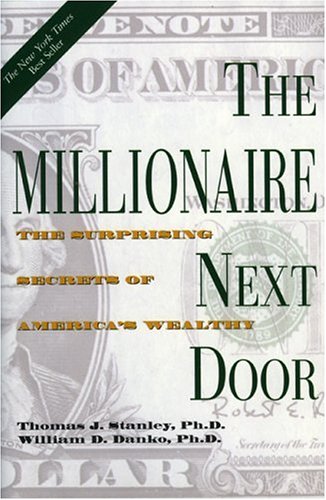
The Millionaire Next Door
I love having management students at NYU, they love the most interesting, and financially helpful, books. I learned how poor I am compared to the “frugal Sally” or “hand me down Fred” from The Millionaire Next Door: The Surprising Secrets of America’s Wealthy. I’ll admit it here to you all… I am a UAW and not a PAW (I think the acronym sounds better, huh?). Well, a UAW is an “under accumulator of wealth” compared to the few, the proud, the smart PAW (prodigious accumulator of wealth). So in the scheme of life, I would think it can be just as much fun being a UAW, until the time when you can’t work full-time, right? Good question. Hope you all can think upon it. The research study of Profs Stanley and Danko (U of Albany!, right down the street from my parent’s home) is well done. They interviewed numerous millionaires to find out “how they spend” and the findings are somewhat surprising. It certainly will make the person who buys new cars every three years realize what a waste, in terms of long term money accumulation, it can be for an individual. In their research I was actually surprised by how many parents depart “EOC” (Economic Outpatient Care) to their kids. Where’s my money every month? I hope my kids aren’t thinking I will be dropping $15k every month on them. I was actually hoping it would be the other way around. The thesis on how immigrants struggle in the first generation, BUT build an ethic of savings, is so true. My in-laws are great examples of it. Think about two Argentineans coming over on a boat, not knowing English, and in the end owning in full their home in Bergen County, NJ, not a small feat.
In the end, I may never have the accumulation of wealth that many seek, but I hope by the way I lead my life, I will be wealthy with the amount of friends and dedicated family members I have. There is another set of goals in life, right? Quick read. For parents, some seriously good things to teach our kids, “learn to pay your own way!”
Subscribe to:
Posts (Atom)